About Psammobates oculifer (Kuhl, 1820)
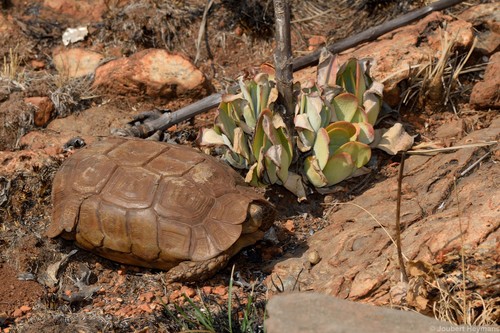
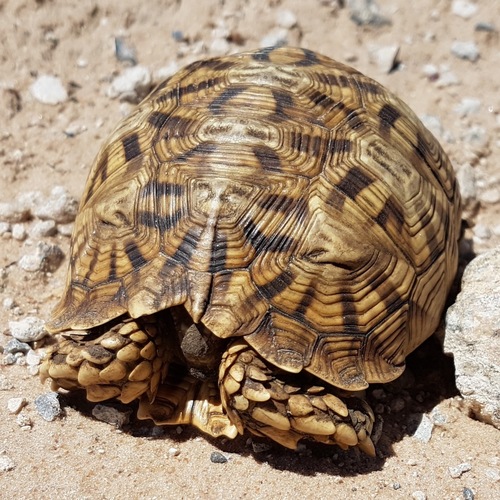
Psammobates oculifer is a relatively small tortoise species, reaching a shell length of 12–15 cm. It shares many superficial outer traits with other relatives in the genus Psammobates, but can be distinguished by its relatively low-domed shell, which is strongly serrated along both its front and back margins. Each shell scute features a radiating star-shaped pattern of black rays on a tan background. This species has buttock tubercles, and its shell's nuchal scute is wide and sometimes divided. Males have a longer tail, taller, more conical scutes on the back, and a concave belly. Females lay a clutch of 1 or 2 eggs in December.
The serrated tortoise is native to Southern Africa, where it prefers arid savanna and scrub desert vegetation types, including Kalahari thornveld, bushveld and arid grassland. Its range spans the border regions of Botswana, Namibia, and the Republic of South Africa, extending from extreme western Transvaal and western Orange Free State northwestward across most of Botswana and central and eastern Namibia. This range roughly matches the extent of the Kalahari Desert, and within this area the species has a very sparse population; individual tortoises are normally very rare and widely separated.
Historically, the San used the shells of these small tortoises to make tobacco and perfume cases. Today this practice is restricted, due to nature conservation legislation enacted to protect this declining species. This tortoise feeds on specific succulents and other plant species native to the Kalahari. Because of its specialized diet, it does not usually survive in captivity and typically dies soon after being removed from its natural habitat. Even so, it remains threatened by illegal collection for the pet trade.