About Psammechinus miliaris (P.L.S.Müller, 1771)
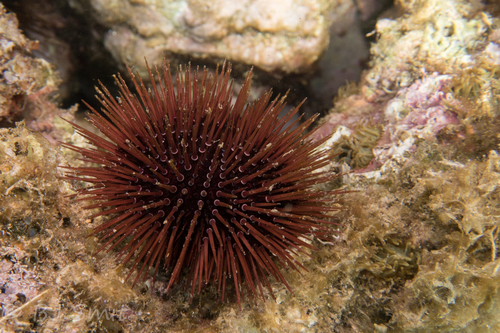
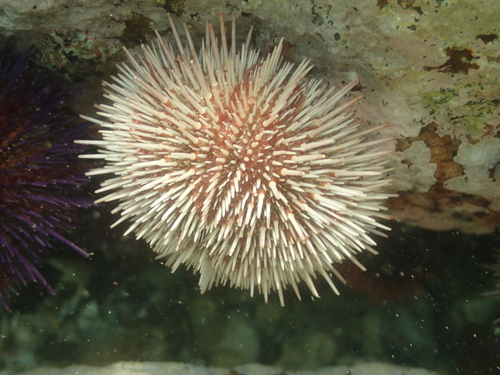
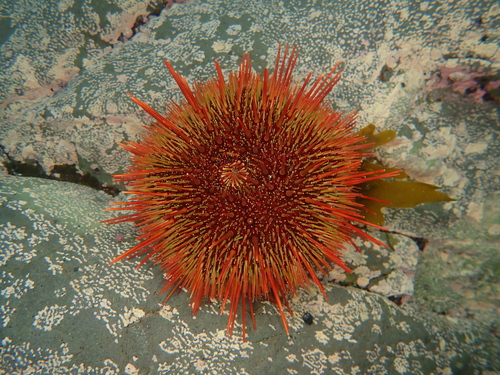
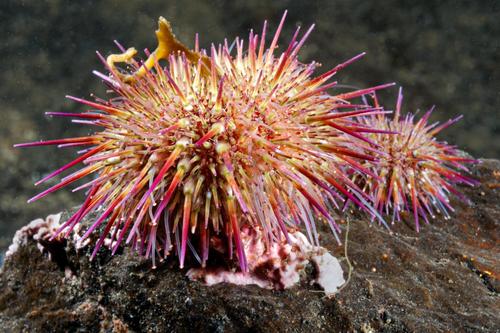
Psammechinus miliaris can reach a maximum diameter of 5.75 cm (2.26 in), with its rigid test (internal skeleton) growing up to 5 cm in diameter. The test is globular in shape and somewhat flattened along the dorso-ventral axis. The entire body is covered in short, robust spines of equal length. Shallow-water individuals have purplish-brown tests and spines, while deeper-water specimens have greenish tests and pale spines with purple tips. If an individual is moved between different depth ranges, it keeps its original coloration in the new location. Each ambulacral plate has three pairs of tubercles, each holding one attached spine; the central tubercle on each plate supports a primary spine. On the ventral (underside) of the animal, the openings are relatively small, and the buccal membrane around the mouth is tightly filled with thick plates that hold many pedicellariae (small pincer-like structures) but no spines. Globiferous pedicellariae are numerous but small, while tridentate pedicellariae are stout and have broad blades. Psammechinus miliaris is found in the eastern Atlantic Ocean, ranging from Scandinavia south to Morocco, and is not present in the Mediterranean Sea. It is especially common in the North Sea. It is mostly a littoral (shore zone) species, but can be found from the low tide mark down to a depth of 100 metres. It is often found on or under Saccharina latissima, a large brown seaweed that shares its range. It also lives in a variety of other habitats: under boulders and rocks, among seaweed, on rough terrain like oyster banks, in burrows in gravelly sediment, and on the rhizomes of Zostera marina in seagrass meadows. Its larvae often settle on human-made structures such as ropes near aquaculture facilities. The gonads of P. miliaris are sometimes eaten, particularly in Mediterranean cuisine. Wild-caught individuals have small gonads, but gonads grow larger in individuals that feed on prepared salmon feed, so the possibility of commercial aquaculture for this species is currently being investigated.