About Psaltoda plaga (Walker, 1850)
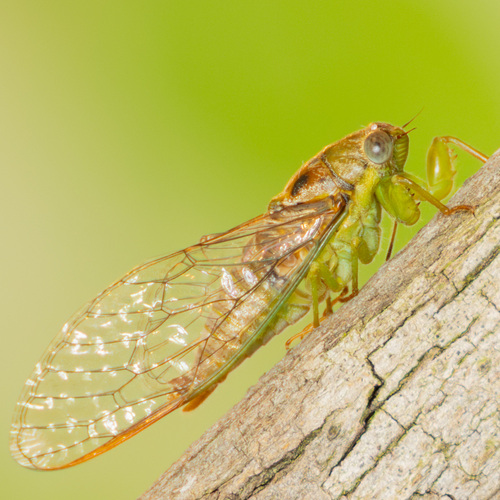
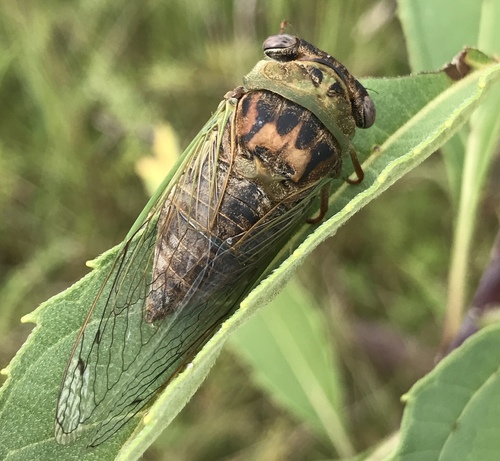
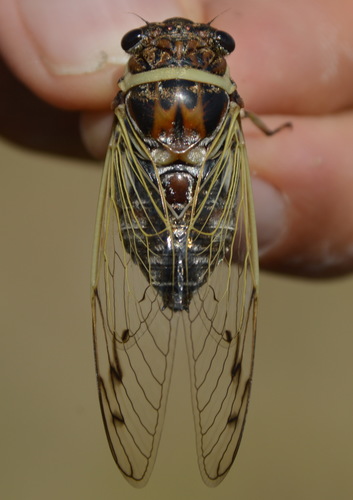
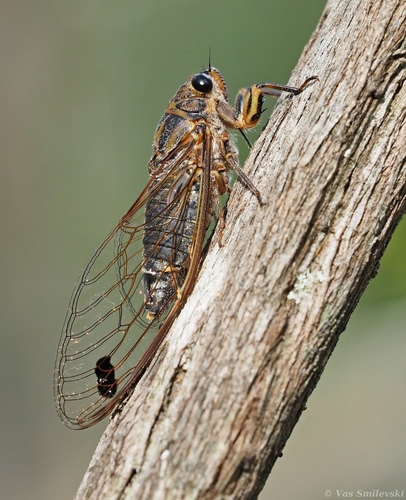
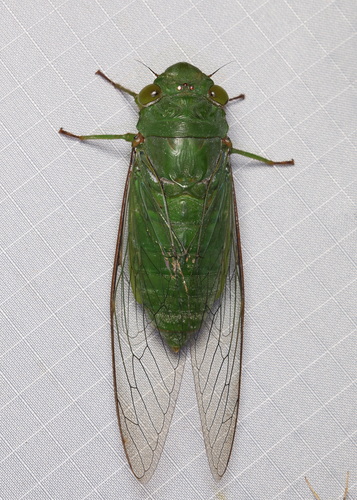
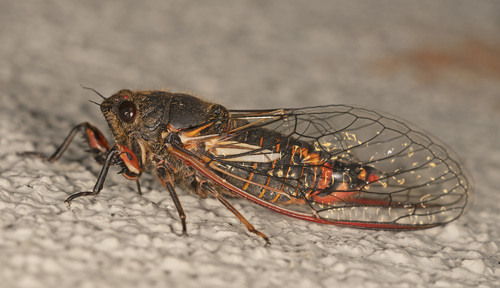
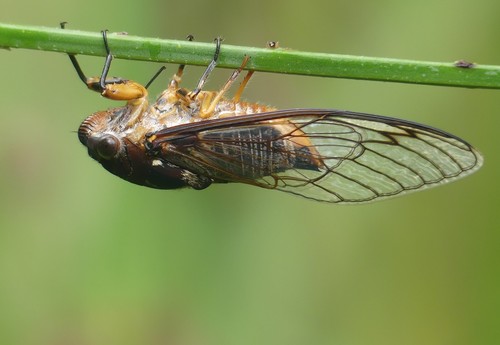
Commonly known as the black prince, Psaltoda plaga (Walker, 1850) can be recognized by a zigzag dark marking (infuscation) on its forewing near the apex, while its hindwing lacks dark infuscation along the border, which distinguishes it from the related species Psaltoda moerens. Adult males have a forewing length of 38 to 47 mm, and adult females are slightly smaller, with a forewing length of 37 to 45 mm. The body colour of adult black princes varies with both age and location. From around Sydney north to the Hunter River, individuals are very dark, predominantly black, with some brown markings; the abdomen is black on its upper side and brown on its lower side, and the eyes are brown. Further north, from Brunswick Heads to Coolum Beach, black princes have more green markings instead of brown, and are lighter in overall colouration. Individuals with green and black markings resemble Psaltoda magnifica, the green baron of North Queensland. The male calling song has two components: rhythmic revving that is more common in cooler weather, and a continuous call that is more common in hot weather. The black prince is found from the vicinity of Maryborough, Queensland, through eastern New South Wales to Bega on the state’s south coast. While it can range inland as far as Stanthorpe, Warwick, Inverell, Coonabarabran, Molong and Cowra, it is generally more abundant in coastal areas. It can occur locally in very large numbers, sometimes in mountainous areas up to 1000 m (3300 ft) in altitude, forming swarms in some summers. In western Sydney, the species has been recorded emerging every year, with activity mainly between December and March. Its habitat requires permanent water such as rivers and swamps. Preferred host trees include broad-leaved paperbark (Melaleuca quinquenervia), mangroves, river sheoak (Casuarina cunninghamiana), rough-barked apple (Angophora floribunda), English sycamore (Acer pseudoplatanus) and weeping willow (Salix babylonica). A study at three western Sydney sites found the species associated with white feather honeymyrtle (Melaleuca decora) and swamp sheoak (Casuarina glauca). Black prince cicadas perch on branches rather than tree trunks. This cicada spends seven years underground as a nymph, feeding on sap from plant roots, before emerging as an adult. Known host plants for nymphs include weeping willow, river sheoak, rough-barked apple, and various eucalypts. Adults live for four weeks, and spend their adult lives flying, mating, and breeding over the summer. In one field study in southeastern Queensland, black princes emerged en masse over a 10 to 15-day period from late November to early December. Successive nymphs emerged in gradually decreasing numbers over the following 75 to 80 days, until early March. During peak emergence, up to 300 cicadas can alight on a single tree.