About Psaltoda moerens (Germar, 1834)
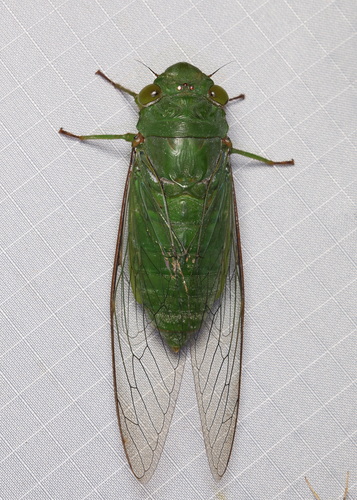
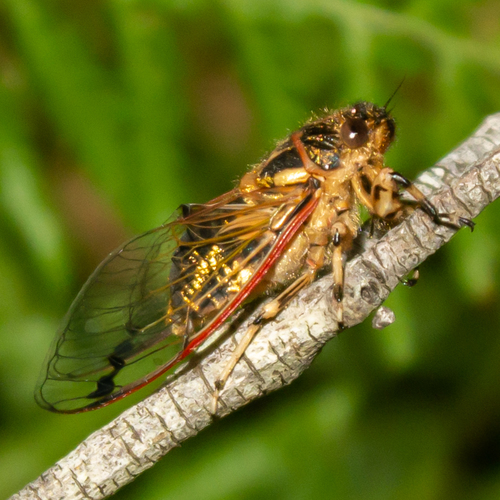
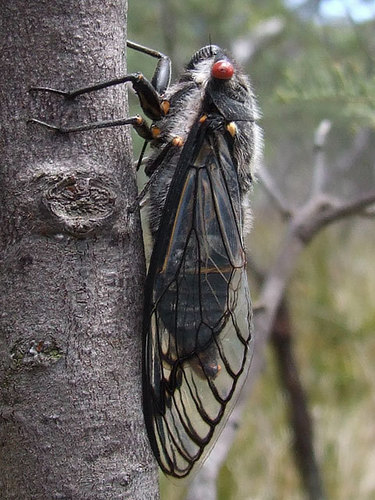
Psaltoda moerens (Germar, 1834), commonly known as the redeye, has a typical wingspan of 110–120 mm. Adult individuals are shiny black on the upper body, and brown with fine hairs on the underside. As the common name suggests, most have deep red eyes, though some specimens have pinkish or brownish eyes. The species can be heard calling at any time of day. Its call is made up of two to twelve revving sounds, most often around six, with a distinct yodelling quality, followed by a continuous rattling call. The redeye produces the yodelling sound by flexing its abdomen upwards. Redeyes are only encountered from November to February. Their range extends from the New England region of south-east Queensland through New South Wales, into Victoria and south-eastern South Australia, as well as Eastern and Northern Tasmania. Within this range, they occur from the coast inland to Toowoomba and Inverell in the north, and to the Grampians and Mount Lofty Ranges in the south. They occupy higher elevations in the northern parts of their range, and low altitudes in the southern parts. In western Sydney, they only appear irregularly, present in some summers and absent in others. The redeye prefers open sclerophyll forest, especially smooth-barked eucalypts and Angophora species, but will use rough-barked species if preferred trees are not available. Favoured host tree species include Sydney red gum, also called smooth-barked apple (Angophora costata), scribbly gum (Eucalyptus racemosa), grey box (Eucalyptus moluccana) and narrow-leaved apple (Angophora bakeri) around Sydney; Eucalyptus grandis near Taree; manna gum (Eucalyptus viminalis); and messmate stringybark (Eucalyptus obliqua) near Adelaide. Redeyes have also been recorded settling on introduced trees including liquidambar (Liquidambar styraciflua), Japanese maple (Acer palmatum), and weeping willow (Salix babylonica). Redeyes settle on the trunks of smoother barked trees, and on the smoothest sections of bark on rougher trees. They may gather in large numbers on some trees while ignoring other adjacent trees. In some cases, many thousands of redeyes can inhabit just a few trees.