About Prunus virginiana L.
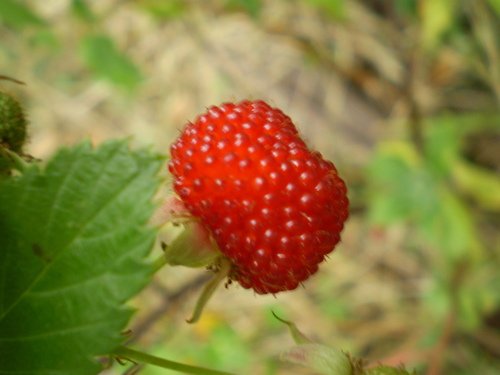
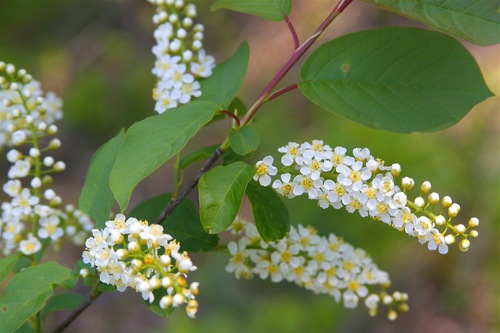
Prunus virginiana L., commonly known as chokecherry, is a suckering shrub or small tree. It typically grows 1 to 6 metres (3+1⁄2 to 19+1⁄2 feet) tall, rarely reaching 10 m (33 ft), and can exceptionally reach 18 m (60 ft) wide with a trunk up to 30 centimetres (12 in) thick. Its leaves are oval, 2.5–10 cm (1–4 in) long and 1.2–5 cm (1⁄2–2 in) wide, with serrated margins. Stems rarely grow longer than 2 cm (3⁄4 in). Flowers grow in racemes that are 4–11 cm (1+1⁄2–4+1⁄4 in) long when they appear in late spring, well after leaves emerge, and can eventually reach 15 cm long; individual flowers are 8.5–12.7 millimetres (3⁄8–1⁄2 in) across. The fruits are drupes around 6–14 mm (1⁄4–1⁄2 in) in diameter, ranging in color from bright red to black. They have a strongly astringent, somewhat sour and bitter taste, becoming darker and marginally sweeter as they ripen, and each contains a large central stone.
Its natural historic range covers most of Canada (including the Northwest Territories, but excluding Yukon, Nunavut, and Labrador), most of the United States (including Alaska, but excluding some southeastern states), and northern Mexico (the states of Sonora, Chihuahua, Baja California, Durango, Zacatecas, Coahuila, and Nuevo León). It grows in a variety of habitats from streambanks to montane forests.
Wild chokecherry is often considered a pest because it acts as a host for tent caterpillars, which threaten other fruit plants. It is also a larval host plant for the black-waved flannel moth, blinded sphinx, cecropia moth, coral hairstreak, cynthia moth, elm sphinx, Glover's silkmoth, hummingbird clearwing moth, imperial moth, Io moth, polyphemus moth, promethea moth, red-spotted purple, small-eyed sphinx, spring azure, striped hairstreak, tiger swallowtail, twin-spotted sphinx, and Weidemeyer's admiral. Many types of wildlife, including birds and game animals, eat its berries. Moose, elk, mountain sheep, deer, and rabbits eat its foliage, twigs, leaves, and buds; deer and elk sometimes browse the twigs heavily enough to keep the plant from growing above knee height. The leaves are also eaten by caterpillars of various Lepidoptera species.
The fruit stone is poisonous. Chokecherry foliage and other plant parts are toxic to ruminants (animals with segmented stomachs) including moose, cattle, goats, and deer, especially after the leaves wilt (such as after frost or broken branches), as wilting releases cyanide and gives the plant a sweet taste. Consumption of 4.5–9 kilograms (10–20 pounds) of chokecherry foliage can be fatal for these animals. In horses, poisoning causes symptoms including heavy breathing, agitation, and weakness.
Several chokecherry cultivars exist in cultivation. 'Canada Red' and 'Schubert' produce leaves that mature to purple, then turn orange and red in autumn. 'Goertz' produces non-astringent, palatable fruit. Research at the University of Saskatchewan works to identify or develop new cultivars to improve production and processing.
For many Indigenous tribes of the Northern Rockies, Northern Plains, and boreal forest region of Canada and the United States, chokecherries are the most important fruit in traditional diets, and are an ingredient in pemmican, a traditional staple food. Indigenous people make a rough-textured preparation from chokecherry root bark to prevent or treat colds, fever, and stomach problems. Some tribes use chokecherry inner bark mixed with red osier dogwood or alder in ceremonial smoking mixtures called kinnikinnick. Chokecherry fruit can be eaten when fully ripe, but is toxic when unripe. The fruit can be used to make jam or syrup, but its natural bitterness requires added sugar to make palatable preserves. Plains Indians pounded whole chokecherry fruits including their pits in a mortar to make sun-baked cakes. Chokecherry is also used to make wine in the Western United States, mainly in the Dakotas and Utah, as well as in Manitoba, Canada.