About Prunus tomentosa Thunb.
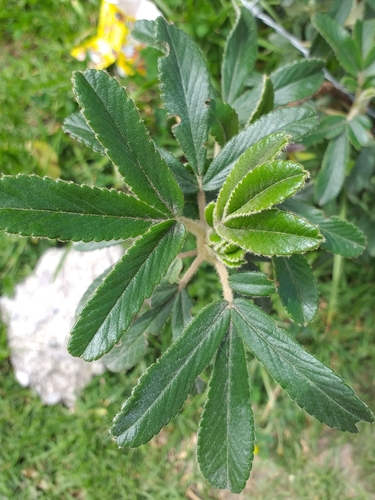
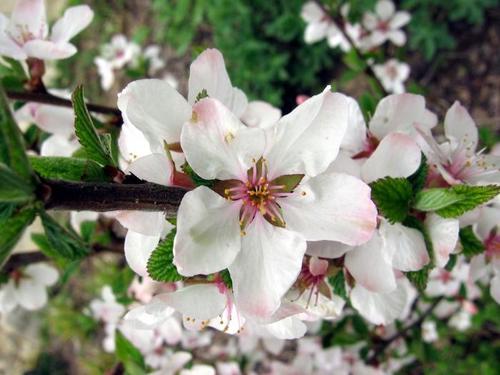
Prunus tomentosa Thunb., commonly known as Nanking cherry, is a deciduous shrub with an irregular growth shape. It typically reaches 0.3 to 3 meters in height, rarely growing as tall as 4 meters, and may be slightly wider than it is tall. Its bark is glabrous, with a copper-tinted black color. The leaves are arranged alternately, measure 2 to 7 cm long and 1 to 3.5 cm broad, and have an oval to obovate shape. They end in an acuminate tip, have irregularly serrate margins, are rugose and dark green, are pubescent on the upper surface and tomentose on the lower surface, and grow from glandular petioles. Its flowers are white or pink, set within a scarlet calyx, and open in spring either at the same time as or before the leaves emerge. Flowers are consistently profuse, arranged in clusters on scarlet pedicels, and measure 1.5 to 2.0 cm in diameter. The fruit is a scarlet drupe 5 to 12 mm in diameter (rarely up to 25 mm), that ripens in early summer. It has a sweet but slightly tart flavor and contains a large seed. Though it is often called a cherry and superficially resembles true cherries, Nanking cherry is more closely related to plums than to true cherries. This species prefers full sun and grows naturally in a wide range of soil types. It is drought-resistant, and cold-hardy to USDA hardiness zone 2. This plant has been widely cultivated across eastern Asia for a very long time for its flowers and fruit. It was first introduced to the British Isles in 1870, and was brought to the United States by the Arnold Arboretum in 1892. It is cultivated for multiple uses. Its edible fruit is used as an ingredient in juice, jam, and wine, and is also added to pickled vegetables and mushrooms. It is also grown as an ornamental plant, valued for its attractive flowers and fruit. It may be pruned to form bonsai, twin-trunk shapes, or clump shapes, or left to grow in an upright form. It is used as dwarfing rootstock for other cherry varieties. In Manchuria and the Midwest United States, the shrub is planted in hedgerows to serve as a windbreak. When under cultivation, it grows best in well-drained, slightly acidic soil. Several named cultivars are grown in cultivation. Examples include 'Graebneriana' from Germany, 'Insularis' from Japan and Korea, 'Leucocarpa' from Manchuria which produces white fruit, and 'Spaethiana' from Europe.