About Prunus susquehanae Willd.
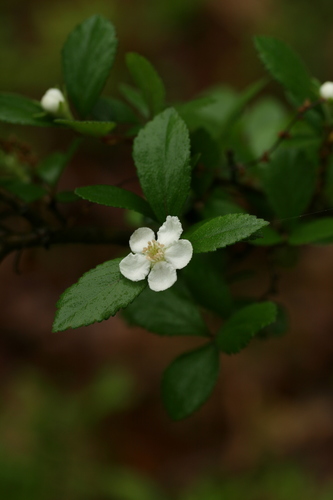
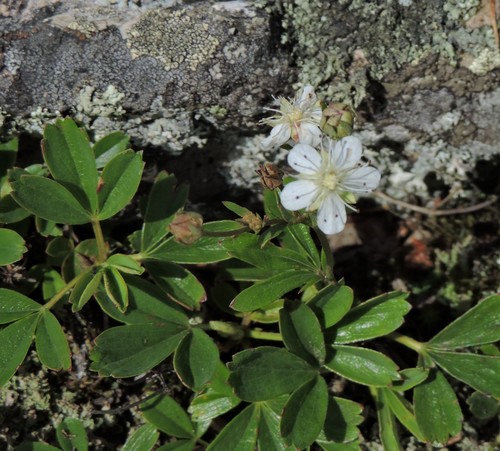
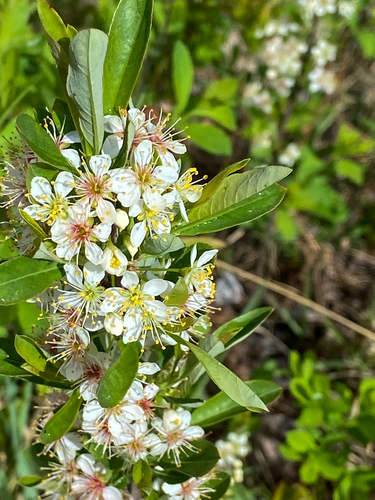
The plant referenced by the scientific name Prunus susquehanae Willd. is currently classified as Prunus pumila var. susquehanae, a variety of Prunus pumila. Prunus pumila, commonly known as sand cherry, is a North American cherry species belonging to the rose family. It is widespread across eastern and central Canada, ranging from New Brunswick west to Saskatchewan, and across the northern United States from Maine to Montana, extending south as far as Colorado, Kansas, Indiana, and Virginia. A small number of isolated populations are also found in Tennessee and Utah. It grows in sandy habitats including shorelines and dunes. Prunus pumila is a deciduous shrub that reaches 0.61–1.83 metres (2–6 feet) in height, with size varying by variety. It forms dense clonal colonies via sprouts growing from its root system. Its leaves are leathery, measure 4–7 centimetres (1+5⁄8–2+3⁄4 inches) long, and have serrated margins. Its flowers are 15–25 millimetres (9⁄16–1 inch) in diameter, with five white petals and 25–30 stamens, and grow in small clusters of two to four. The fruit is a small cherry 13–15 mm (1⁄2–9⁄16 inch) in diameter, which ripens to a dark purple color in early summer. Four recognized varieties of Prunus pumila are documented: Prunus pumila var. besseyi (Bailey) Gleason, common name western sand cherry (also called Rocky Mountain cherry), distributed from Saskatchewan, Manitoba, and western Ontario south to Colorado and Kansas; Prunus pumila var. depressa (Pursh) Gleason, common name eastern sand cherry, distributed from Ontario, Québec, and New Brunswick south to Pennsylvania; Prunus pumila var. pumila, common name Great Lakes sand cherry, found on the shores of the Great Lakes; and Prunus pumila var. susquehanae (hort. ex Willd.) Jaeger, common name Susquehana sand cherry, distributed from Manitoba east to Maine, and south to Tennessee. Prunus × cistena, commonly called purple leaf sand cherry, is a hybrid between Prunus cerasifera (cherry plum) and P. pumila. This hybrid was developed by Niels Ebbesen Hansen of South Dakota State University in 1910. It grows to around 2.1 m (7 ft) tall and can live up to 20 years.