About Prunus spinosa L.
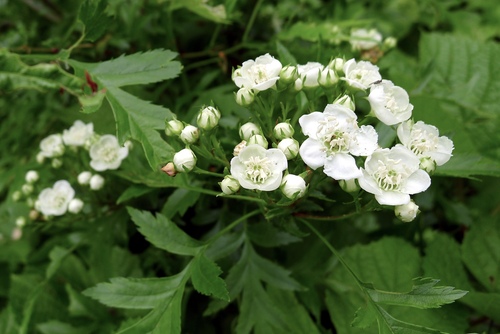
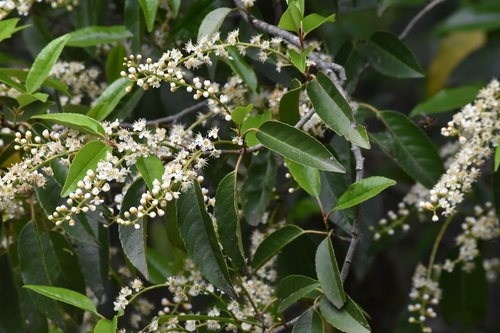
Prunus spinosa L., commonly called blackthorn, is a large deciduous shrub or small tree that typically grows 5 metres (16 ft) tall, though it can occasionally reach 6 m (20 ft) as a full tree. It has blackish bark, dense stiff spiny branches, and its branches usually grow into a tangled thicket. Its leaves are oval, 2–4.5 centimetres (3⁄4–1+3⁄4 inches) long and 1.2–2 cm (1⁄2–3⁄4 in) broad, with a serrated margin. The flowers are approximately 1.5 cm (1⁄2 in) in diameter, with five creamy-white petals. They emerge before the leaves in early spring, are hermaphroditic, and pollinated by insects. The fruit is called a sloe, a drupe 10–12 millimetres (3⁄8–1⁄2 in) in diameter that is black with a purple-blue waxy bloom and ripens in autumn. In the United Kingdom, sloes are traditionally harvested in October or November, after the first frosts, because frost softens the skin and makes it easier to process for making sloe gin. Fresh sloes are thin-fleshed and have a very strongly astringent flavour. On average, individual fruits persist for 36.7 days, hold 1 seed each, and are 77.6% water by weight. The dry weight of sloes contains 10.6% carbohydrates and 0.6% lipids. Like many other stone fruits, the hard pit of a sloe contains trace amounts of hydrogen cyanide. Prunus spinosa has a tetraploid set of chromosomes, with 2n=4x=32. It is frequently confused with the related species Prunus cerasifera (cherry plum), especially in early spring when cherry plum flowers earlier than blackthorn. The two can be distinguished by multiple features: cherry plum has pure white flowers, while blackthorn has creamy-white flowers; cherry plum has sepals that bend backwards, which blackthorn sepals do not. In winter, they can be told apart by blackthorn's shrubbier growth habit and stiffer, wider-angled branches. In summer, blackthorn can be identified by its relatively narrower leaves, which are more than twice as long as they are broad. In autumn, the fruit skin colour differs: blackthorn fruit is purplish black, while cherry plum fruit is yellow or red. Prunus spinosa is native to Europe, western Asia, and occurs locally in northwest Africa. It is also locally naturalized in Tasmania and eastern North America. Ecologically, its foliage is sometimes eaten by the larvae of many Lepidoptera species: the small eggar moth, emperor moth, willow beauty, white-pinion spotted, common emerald, November moth, pale November moth, mottled pug, green pug, brimstone moth, feathered thorn, brown-tail, yellow-tail, short-cloaked moth, lesser yellow underwing, lesser broad-bordered yellow underwing, double square-spot, black hairstreak, brown hairstreak, hawthorn moth (Scythropia crataegella) and the case-bearer moth Coleophora anatipennella. Dead blackthorn wood provides food for the caterpillars of the concealer moth Esperia oliviella. For human uses, the shrub's long sharp thorns make it traditionally used in Britain and other parts of northern Europe to create cattle-proof hedges. Its fruit is similar to a small damson or plum, suitable for making preserves, but is too tart and astringent to eat fresh unless picked after the first few days of autumn frost. This softening effect can also be achieved by freezing harvested sloes artificially. Because the plant is hardy and grows well in a wide range of conditions, it is used as a rootstock for many species of plum, as well as some other types of fruit tree.