About Prunus maritima Marshall
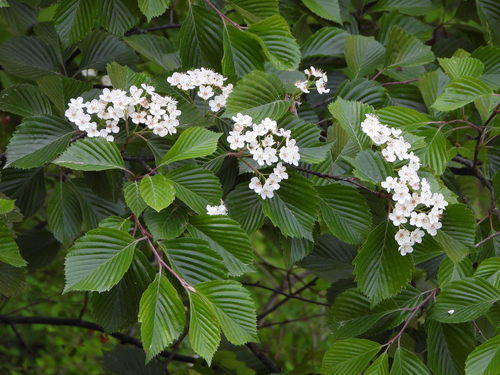
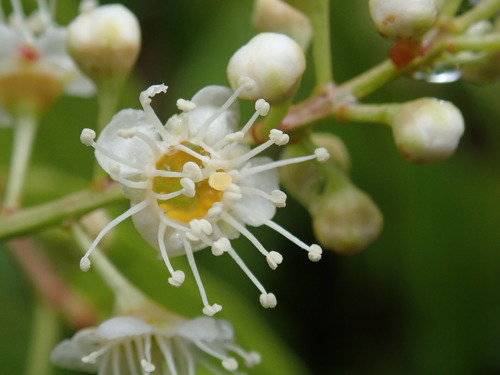
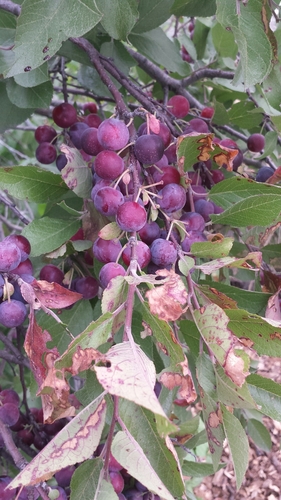
Prunus maritima Marshall is a deciduous shrub. In its natural sand dune habitat, it grows 1 to 2 meters (3 1⁄2 to 6 1⁄2 feet) tall, and it can grow larger when cultivated in gardens, reaching up to 4 m (13 ft) tall. Its leaves are alternate and elliptical, measuring 3 to 7 centimeters (1 1⁄4 to 2 3⁄4 inches) long and 2 to 4 cm (3⁄4 to 1 1⁄2 inches) broad, with a sharply toothed margin. The leaves are green on the upper surface and pale on the lower surface, turning showy red or orange in autumn. Its flowers are 1 to 1.5 cm (3⁄8 to 5⁄8 in) in diameter, with five white petals and large yellow anthers. The fruit of wild plants is an edible drupe 1.5 to 2 cm (5⁄8 to 3⁄4 in) in diameter, and can be red, yellow, blue, or nearly black. This species is salt tolerant and cold hardy, and prefers full sun and well-drained soil. It spreads via root suckers, but develops a taproot in coarse soil. In dunes, it is often partly buried by drifting sand. It blooms from mid-May through June, and its fruit ripens in August and early September. This species is classified as endangered in Maine, where it has experienced serious decline caused by commercial development of its beach habitats. Its natural range extends from Maine south to Maryland. While it is sometimes reported to range north to New Brunswick, Canada, no confirmed collections of the species exist from that area, and it is not included in the most authoritative works on the province's flora. This species is grown commercially for its fruit, which is used to make value-added products like jam. Ripe fruit has a generally sweet flavor, though individual bushes vary, with some producing sour or slightly bitter fruit. These beach plums are about the size of grapes, much smaller than the longer-cultivated Asian varieties sold in supermarkets, but are resistant to many common North American stone fruit pests, such as black knot fungus. Several cultivars have been selected for larger, better-flavored fruit, including Resigno, Jersey Gem (Rutgers), ECOS, Eastham, Hancock, and Squibnocket. Natali Vineyards in Goshen, New Jersey produces wine from beach plums, and Greenhook Ginsmiths in Greenpoint, Brooklyn, New York makes gin flavored with beach plums. The seed pits of the fruit are toxic because they contain hydrocyanic acid.