About Prunus ilicifolia (Nutt. ex Hook. & Arn.) D.Dietr.
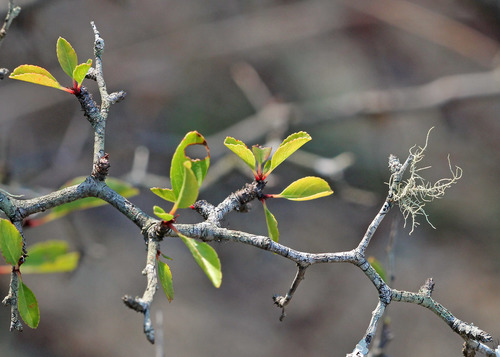
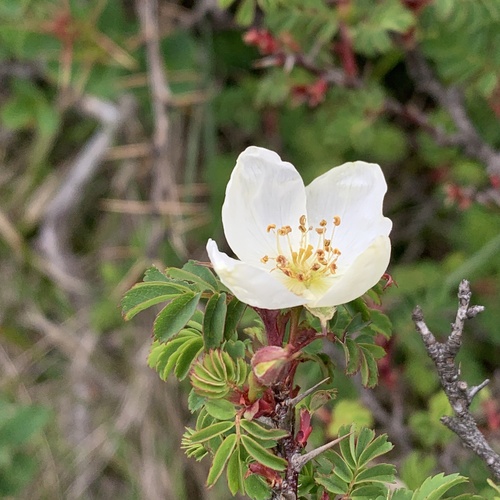
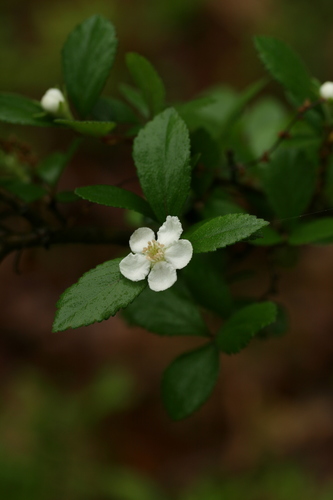
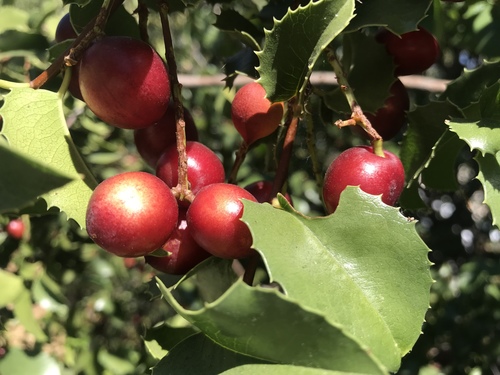
Prunus ilicifolia (Nutt. ex Hook. & Arn.) D.Dietr. is an evergreen shrub or small tree that can grow close to 15 metres (49 feet) tall, with dense, hard sclerophyllous foliage. Its leaves range from 1.6–12 centimetres (3⁄4–4+3⁄4 inches) long, with 4–25 millimetre (1⁄8–1 inch) petioles and spiny margins that resemble holly leaves. Mature leaves are dark green, generally shiny on the upper surface, and smell like almonds when crushed. The leaves are poisonous to eat, but safe to handle. The plant produces small 1–5 mm white flowers in racemes during the spring. Its fruit is a cherry 12–25 mm in diameter, sweet in flavor, with only a small amount of flesh surrounding a smooth seed. Prunus ilicifolia is native to California chaparral and foothill woodlands along the Coast Ranges below 1,600 m (5,200 ft). Its distribution extends from northern Baja California along the California coast to the northern end of the Coast Ranges, and also reaches into the desert chaparral areas of the Mojave Desert. Within chaparral communities, it most often grows on north-facing slopes, erosion channels, and other cool, moist sites. It is the only species of the genus Prunus native to California's Santa Monica Mountains, which separate the Los Angeles Basin from the San Fernando Valley. It is a persistent, slow-growing but long-lived member of chaparral communities; common associated chaparral plants are toyon, western poison-oak, and coffeeberry. In the absence of fire, P. ilicifolia outlives or outshades surrounding vegetation to create space for its seedlings, and eventually forms extensive stands codominated by scrub oak. Unlike many other chaparral plants, the seeds of P. ilicifolia are not fire-adapted, though the plant can resprout from its stump after fires. Instead, it relies on the natural death of surrounding vegetation during long fire-free periods to open space for its seedlings. While seeds are often reported to need sunlight to germinate, wild-collected seeds buried completely in pots with peatlite mix have achieved germination rates of nearly 100%. This plant serves as a food source for caterpillars of the pale swallowtail (Papilio eurymedon), and is also a larval host plant for the California hairstreak, Lorquin's admiral, Nevada buckmoth, and western tiger swallowtail. Bees are attracted to the plant. Prunus ilicifolia is grown in California native plant gardens, wildlife gardens, and drought-tolerant sustainable landscaping. The sweet pulp of its cherry fruit is edible, but the seeds are considered toxic, so the plant material must go through specific leaching processes to be safe for human consumption. Native Americans fermented the fruit to make an intoxicating drink, and some groups cracked dried cherries to make meal from the seeds after grinding and leaching. The fruit has also been made into jam. The traditional preparation process for using the seed involved extracting and crushing the kernel in a mortar, then leaching the resulting powder to remove harmful compounds. The leached powder was then boiled into atole, and the finished meal was used to make soup base, tortillas, or tamale-like foods. Alternately, whole kernels could be leached to remove hydrocyanic acid, roasted for several hours, and then used to make cakes or balls. Beyond food uses, some Native Californian tribes including the Diegueño and Cahuilla used the plant for medicinal purposes: infusions made from its bark and roots were used to treat common colds and coughs.