About Prunus grayana Maxim.
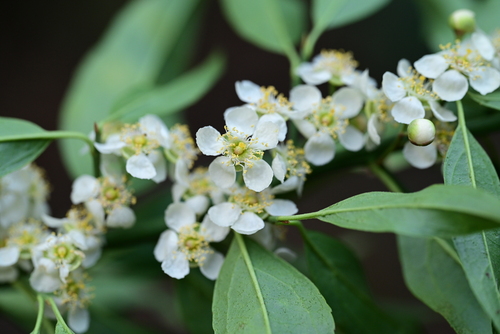
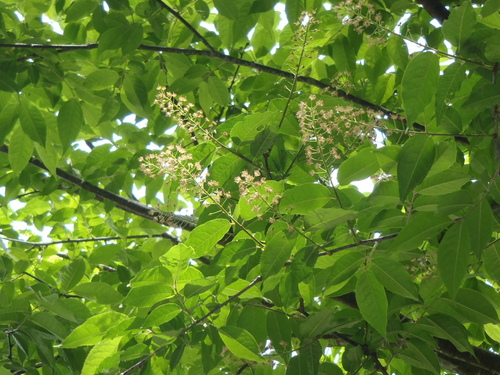
Prunus grayana Maxim., with synonyms including Padus grayana (Maxim.) C.K.Schneid. and Prunus padus var. japonica Miq., is commonly called Japanese bird cherry or Gray's bird cherry. It is known as ウワミズザクラ (Uwa-mizu-zakura) in Japanese and 灰叶稠李 (hui ye chou li) in Chinese. This species of bird cherry is native to Japan and China, where it grows at medium altitudes between 1,000 and 3,800 m in the temperate zone. It prefers full sun and moist, well-drained soil. It is a small deciduous tree that grows to a height of 8–20 m. It has a slender trunk with smooth grey to purple-grey bark marked by horizontal brown lenticels, which gives off a strong odor when cut. Its leaves are elliptical to ovoid, 4–10 cm long and 1.8–4.5 cm broad, with serrated margins; each serration has an aristate tip. The lowest teeth on each leaf have two glands. Flowers grow in racemes 5–8 cm long; each flower is 7–10 mm in diameter, with five white petals. Flowers are hermaphroditic and bloom in mid-spring, after leaves have emerged. The fruit is a small drupe around 8 mm in diameter. It starts green, turns red, and ripens to black in mid-summer. Prunus grayana is very closely related to Prunus padus (Bird cherry), but differs from it by having aristate tips on its leaf serrations (Prunus padus has blunt-pointed tips) and a longer style in its flower. All parts of Prunus grayana including its flowers, fruit, and seed are edible, and are prepared and eaten in Japan. Fruit can be preserved with salt to make a dish called Anningo. A green dye can be obtained from its bark and roots. Its wood is very hard and splits easily, and is used for cabinet-making and various other ornamental applications.