About Prunus glandulifolia Rupr.
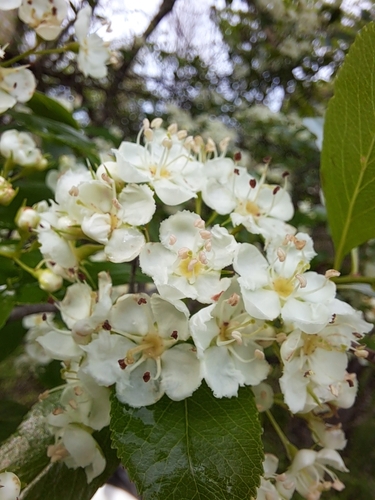
Scientific name: Prunus glandulifolia Rupr. Prunus maackii, commonly known as Manchurian cherry or Amur chokecherry, is a cherry species native to Korea, both banks of the Amur River in Manchuria (northeastern China), and Amur Oblast and Primorye (southeastern Russia). It was previously classified in Prunus subg. Padus, but both morphological and molecular studies confirm it belongs to Prunus subg. Cerasus. It is a deciduous tree that reaches 4–10 m in height. Young trees have very distinctive smooth, glossy bronze-yellow bark, which becomes fissured and dull dark grey-brown as the tree ages. The leaves are alternate and ovate, measuring 4–8 cm long and 2.8–5 cm broad. It has a 1–1.5 cm pubescent petiole, and a margin that is entire or very finely serrated. Leaves are dark green on the upper surface, and slightly paler with pubescence on the lower veins. Flowers grow on erect spikes 5–7 cm long; each flower is 8–10 mm in diameter, with five white petals. The fruit is a small cherry-like drupe 5–7 mm in diameter. It starts green, turns red, and becomes dark purple or black when mature. Flowering occurs in mid spring, and the fruit ripens from early summer to early autumn. This species was named for Richard Karlovich Maack (1825-1886), who discovered it, and it was described by Ruprecht in Bull. Cl. Phys.-Math. Acad. Imp. Sci. Saint-Pétersbourg 15: 361 (1857). It is cultivated as an ornamental tree in northern Europe and North America, grown primarily for its decorative bark. It prefers full sunlight and moist but well-drained soil. It tolerates severe winter cold, but does not tolerate heat. Its fruit has been used to make juice, jelly, and jam. Cultivated specimens have been recorded reaching 17 m tall with a 90 cm trunk diameter.