About Prunus emarginata (Douglas ex Hook.) Eaton
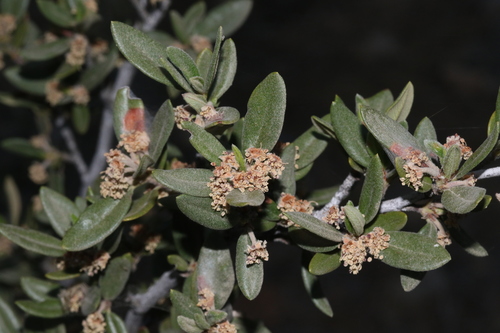
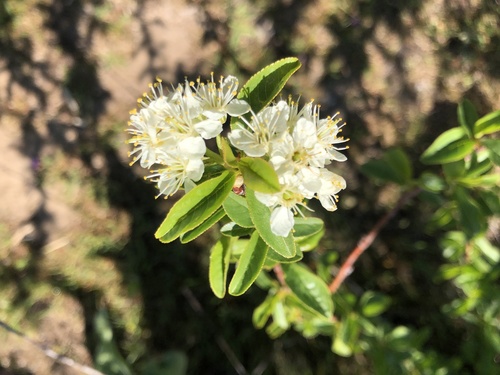
Prunus emarginata (Douglas ex Hook.) Eaton is a deciduous shrub or small tree that typically grows 1–15 metres (3+1⁄2–49 feet) tall; west of the Cascade Range, it commonly reaches 24–30 m (80–100 ft) tall. It has a slender oval trunk and smooth gray to reddish-brown bark marked with horizontal lenticels. Its leaves are 2–8 centimetres (3⁄4–3+1⁄8 inches) long, thin, egg-shaped, and yellowish-green, with unevenly sized teeth along both edges. The flowers are small, 10–15 millimetres (3⁄8–5⁄8 in) in diameter, with five white petals and numerous hairlike stamens. They carry an almond scent, grow in clusters that appear in spring, and are pollinated by insects. The fruit is a juicy red or purple cherry 7–14 mm (1⁄4–1⁄2 in) in diameter, which is bitter, as the plant's common English name suggests. In addition to reproducing by seed, it sends out underground stems that sprout above the surface to form thickets. There are two recognized varieties of this species. Prunus emarginata var. emarginata is usually shrubby, with hairless or only thinly hairy young shoots and leaves, and it occurs across most of the species' full range. Prunus emarginata var. mollis (Dougl.) Brew. grows into a larger tree, with downy young shoots and leaves. It has reddish-brown bark with light horizontal bands that resemble the bark of water birch, and it grows from Oregon north to British Columbia, mainly in coastal areas. This species is native to western North America, ranging from British Columbia south to Baja California, and east as far as western Wyoming and New Mexico. It is most often found in recently disturbed areas or open woods growing on nutrient-rich soil. In its ecosystem, mammals including deer and livestock forage on its leaves. The cherries are eaten by some birds, especially cedar waxwings, which disperse the plant's seeds in the process. The seeds have hard shells that allow them to remain preserved for decades, until germination is triggered after fire releases them. This plant is a larval host for the blinded sphinx, elegant sphinx, Lorquin's admiral, pale tiger swallowtail, small-eyed sphinx, spring azure, twin-spotted sphinx, and western tiger swallowtail. In cultivation, it has hybridized with the introduced European species Prunus avium in the Puget Sound area. The resulting hybrid has been named Prunus × pugetensis, which is intermediate between its two parent species but nearly sterile, producing almost no cherries. The extremely bitter cherries are inedible to humans. Native Americans used the plant's bark for basket making. Native tribes, most notably the Kwakwaka'wakw, used parts of the plant for medicinal purposes, including making poultices and bark infusions. The isoflavone prunetin was first isolated in 1910 by Finnemore from the bark of P. emarginata.