About Prunella montanella (Pallas, 1776)
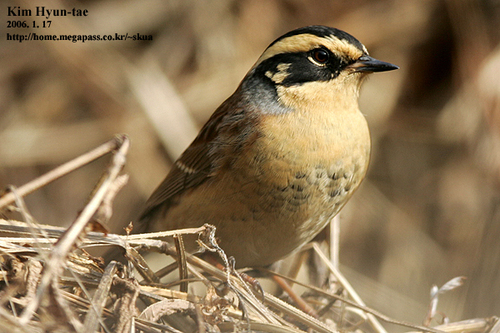
Prunella montanella, commonly known as the Siberian accentor, averages 14.5 centimetres (5.7 in) long and weighs 17.5 grams (0.62 oz). For the adult of the nominate subspecies, the upperparts and wings are brown, with bright chestnut streaking on the back, and a greyish-brown rump and tail. Two narrow whitish bars are visible on the folded wings. The head features a dark brown crown, a long, wide pale yellow supercilium, a blackish patch behind the eye, and grey sides to the neck. The underparts are ochre yellow, turning strongly buff on the flanks and greyish on the lower belly, with rich chestnut streaks along the sides of the breast and flanks. The iris is warm red-brown, the sharply pointed bill is dark, and the legs are reddish. All plumages are broadly similar, though the female has slightly duller underparts with weaker streaking. Juveniles are overall duller, with brown spots on the breast and chest. Autumn juvenile birds also show more wear on their tail feathers and the tertials that cover the folded wing, and they often have a duller iris colour than adults. The subspecies P. m. badia is somewhat smaller and darker than the nominate form, with richer brown upperparts, deeper buff underparts, and rustier flank streaks. Adults undergo a complete moult between July and September, after breeding has finished. Juveniles have a partial moult in the same time period, replacing feathers on the head, body, and some wing coverts. The only species that can potentially be confused with the Siberian accentor is the closely related black-throated accentor, because first-autumn black-throated accentors may have a relatively inconspicuous dark throat. The Siberian accentor can still be distinguished by its rustier back colour, yellow rather than off-white supercilium, and the absence of a white line below the black face mask. The Siberian accentor breeds in a belt across northern Russia eastward from just west of the Ural Mountains to the Pacific coast, with a second, more fragmented breeding band across southern Siberia. It is a migratory species, wintering in east China and Korea. Small numbers of this species winter in Mongolia, and it only occurs rarely in Japan during winter. Its breeding habitat consists of subarctic willow and birch forests, and open coniferous woodland, often located close to rivers or bogs, though breeding pairs are also found in mountains and spruce taiga. In winter, the Siberian accentor lives in bushes and shrubs, often near streams, but it may also be found in dry grassland and woods.