About Prumnopitys ferruginea (G.Benn. ex D.Don) de Laub.
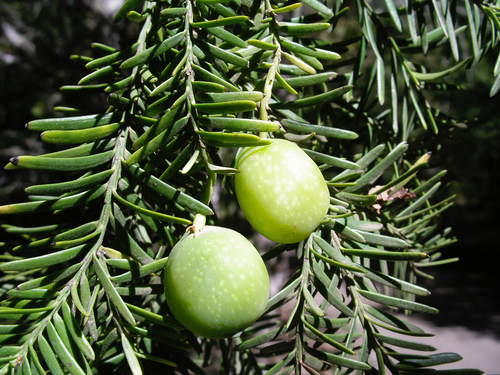
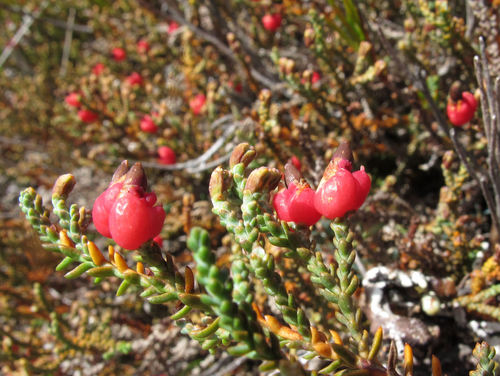
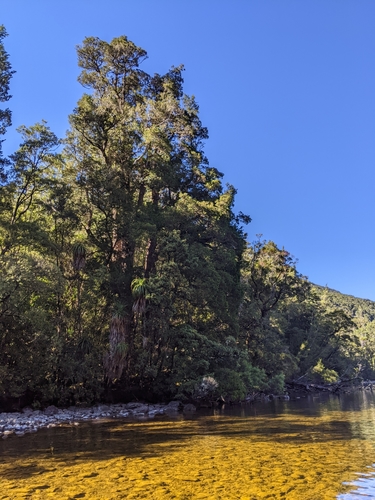
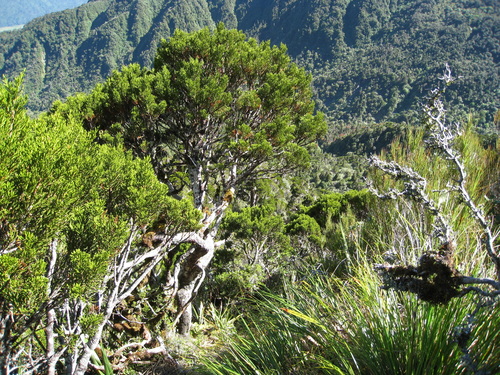
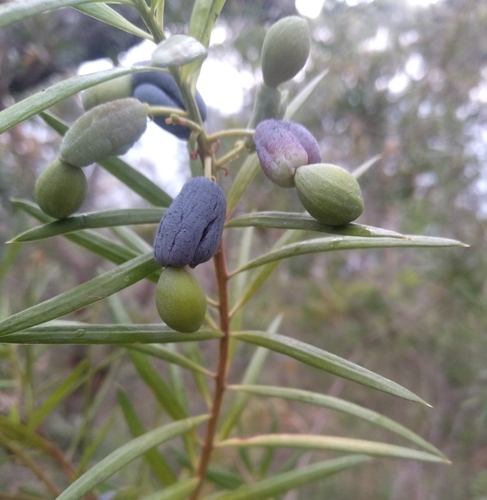
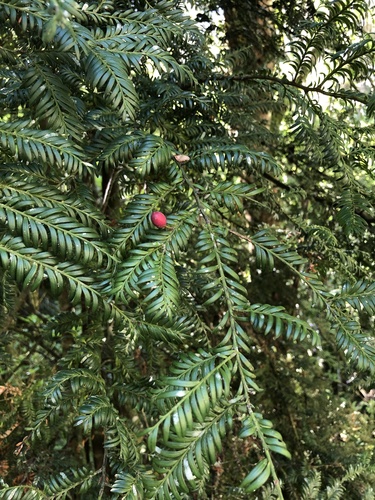
Prumnopitys ferruginea, also known by the synonym Pectinopitys ferruginea and the common name miro, is a species of dioecious evergreen conifer in the family Podocarpaceae. It can reach heights of up to 25 metres (80 feet), with a smooth, cylindrical trunk up to 1–1.5 metres (3 ft 3 in – 4 ft 11 in) in diameter. Its estimated lifespan is 250–350 years, though it may live longer than 750 years; analysis of specimens from Tongariro National Park suggests 770 years is the theoretical age limit. The tree is typically unbranched for the first third of its height. Young branches grow ascending, then mature into spreading branches that form a domed or rounded crown. Its bark is smooth when young, with outer layers peeling naturally over time to become furrowed and shed in thick flakes. Bark is typically dark brown, but may turn blackish-grey, especially on older trees, while the inner bark is purplish and usually marked from separated outer flakes. Leaves on young trees are 15–30 mm long and 1.8–2.7 mm wide, and range in colour from light-green to brownish-red. Leaves on adult trees are shorter, measuring 10–20 mm long and 2–3 mm wide, and are dark green to bronze green. Leaves are distichous, arranged in two opposite rows along the stem, and pectinate, arranged closely together like a comb. They are falcate (sickle-shaped), curved downwards, and taper to a pointed tip. Midribs are distinct, green, and especially prominent on the upper leaf surface. Stomata are located in two bands on the underside of the leaf, separated by the midrib. Like all conifers, P. ferruginea does not produce flowers or fruit; instead, it produces pollen and seed in cones. The species is dioecious, meaning individual trees produce either all male or all female reproductive structures. Cylindrical pollen cones on male trees are 5–15 mm (rarely up to 20 mm) long, 2–3 (rarely up to 4) mm thick, and are axillary, solitary, and located at the tips of leaves. Ovules, the female reproductive structures, on female trees are less than 10 mm long, found on short branchlets, and are usually solitary, rarely paired. These seed cones are typically found at the ends of lateral stems. Seed cones take 12–18 months to mature, and ripe cones are most commonly found from November to April. Like most members of Podocarpaceae, P. ferruginea seeds are adapted for avian seed dispersal (ornithochory). The cone is reduced to a single scale that is highly modified into a fleshy structure holding one or two seeds. This fleshy structure is glaucous, ranges in colour from red to pinkish-red, is oblong to sub-spherical in shape, and grows up to 20 mm long. The hard seed coat (or pyrena) is 11–17 mm long, dark brown to black-brown, and encloses a red seed. At maturity, the cones develop a thin layer of wax. The yellow fleshy pulp under the cone skin is edible, with a flavour described as resembling nutmeg and turpentine. The bright green foliage and pink to red cones of P. ferruginea are not easily confused with any other New Zealand conifer, though young specimens may resemble common yew (Taxus baccata). While it shares similarities with mataī (Prumnopitys taxifolia), the two species can be distinguished by P. taxifolia's purple to black cones and pale bark. P. ferruginea has a diploid chromosome count of 36. This species is endemic to New Zealand, and its range covers the North, South, and Stewart Islands. It is widely distributed across the country, but is more common in the North Island. In the South Island, it occurs mainly in the southern parts of the island. On Stewart Island, further south, it is a dominant or co-dominant tree of the island's forests, and commonly associates with Pseudopanax crassifolius. In the Wellington Region of the North Island, botanist Thomas Kirk noted that P. ferruginea is particularly common on mountain ranges and ridges. It does not naturally occur on the Kermadec and Chatham Islands. The largest known specimens grow in the central North Island, particularly in deep pumiceous soils. In 2013, the IUCN Red List assessed the conservation status of P. ferruginea as "Least Concern", with a evaluated stable population trend. Its 2023 assessment under the New Zealand Threat Classification System was "Not Threatened". P. ferruginea typically inhabits lowland to montane forests, growing from near sea level up to 1,000 m (3,000 ft) above sea level. At some sites in the South Island, its upper elevational limit has risen more than 60 m (200 ft) over the last 150 years, a change likely caused by climate change. It is a slow-growing, highly shade-tolerant tree, with most young specimens growing in forest understories. It grows on similar soil types as Dacrydium cupressinum, and typically occurs alongside other Podocarpaceae species such as Dacrycarpus dacrydioides and Dacrydium cupressinum. It is commonly found on alluvial soils in the South Island's West Coast Region. P. ferruginea cones are an important food source for many New Zealand native birds, and are especially important to kererū (Hemiphaga novaeseelandiae). A 1992 study observed that a single kererū could eat up to 100 fruits a day, and around 10,000 fruits per fruiting season. A single kererū can disperse P. ferruginea seeds up to 10–30 m (30–100 ft) away from the parent tree, and in rare cases may carry seeds over 1 km (0.6 mi) from the host. Kākā (Nestor meridionalis) have been recorded destroying seeds of both P. ferruginea and mataī (Prumnopitys taxifolia). A 1989 study published in the New Zealand Journal of Ecology recorded blackbirds (Turdus merula), brown kiwi (Apteryx australis), kōkako (Callaeas wilsoni), and weka (Gallirallus australis) as fruit dispersers for P. ferruginea. A 2021 study hypothesised that P. ferruginea cones were consumed by the extinct little bush moa (Anomalopteryx didiformis), though in lower quantities than other native species at the study site at Borland Burn in Fiordland National Park. P. ferruginea acts as a host for many native insects, including Ambeodontus tristis, Calliprason sinclairi, and Prionoplus reticularis. Seed-eating moth larvae of Cryptaspasma querula have been recorded feeding on P. ferruginea seeds. P. ferruginea seeds may take up to two years to germinate. The species' fruits reflect some ultraviolet radiation, which is visible to some birds and vertebrates, though they reflect less strongly than fruits of Dacrycarpus dacrydioides. A. E. Beveridge estimated in 1964 that a mature specimen can produce around 32,000 fruits per year. Like all conifers, P. ferruginea ovules are pollinated by wind. Its cones are borne laterally. During pollination, the tip of each cone's central axis grows longer and shifts to a vertical position. Each axis has several thin, non-reproductive bracts (specialised leaves), but typically only the last bract can produce seeds. A pollination drop forms on the slightly swollen cone axis and spreads across its surface, helping to capture pollen efficiently. A 2009 study of fungal endophytes on various Podocarpaceae species found that P. ferruginea had a moderate diversity of endophytes among the species studied. Several genera of fungi found as endophytes on P. ferruginea were Colletotrichum, Cylindrobasidium, Lasiosphaeria, Ophiognomonia, Pezicula, Phomopsis, Phyllosticta, and Xylaria. P. ferruginea has a moderate flammability rate. Historically, P. ferruginea was used for timber, though it was generally considered inferior to the timber of mataī (Prumnopitys taxifolia) and tōtara (Podocarpus totara). Its wood was used to build houses, house beams, furniture, flooring, and weatherboards, and was often used as a substitute for mataī wood. British missionary Richard Taylor described the fruit as "like a plum of a spicy flavour", and noted that an infusion of the bark was used to treat stomach aches. Historically, Māori set up "pigeon traps" near miro trees to catch kererū. European hunters also learned that kererū often gather to feed on the tree's fruits, so they would camp near miro trees to wait to shoot kererū. New Zealand missionary William Colenso reported to botanist Thomas Kirk that Māori knew the species as 'toromiro', a name Kirk believed was primarily used by Māori in the East Cape area. P. ferruginea had several medicinal uses for Māori: the cone pulp was applied to wounds to stop bleeding; its astringent gum (sap) was also used as a styptic to stop bleeding from wounds; and an infusion of bark in water was used to treat stomach aches and bronchitis. P. ferruginea is uncommon in cultivation, and is only found in a limited number of botanical gardens in warmer climates.