About Proutista moesta (Westwood, 1851)
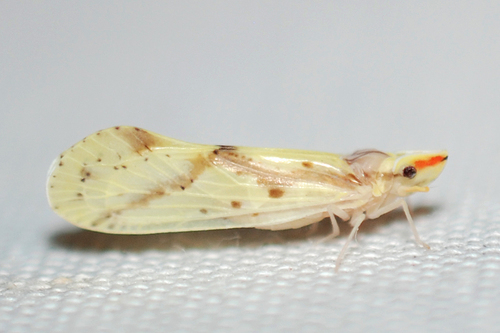
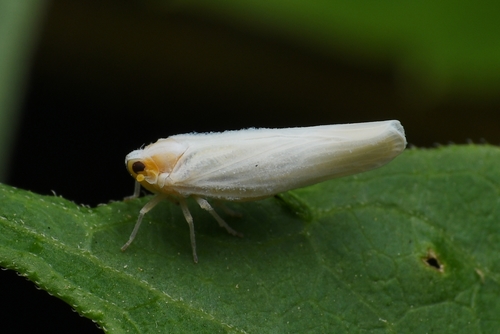
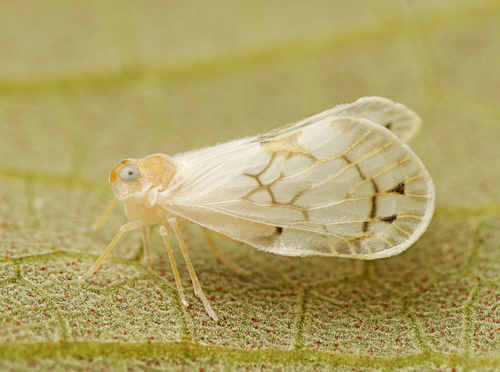
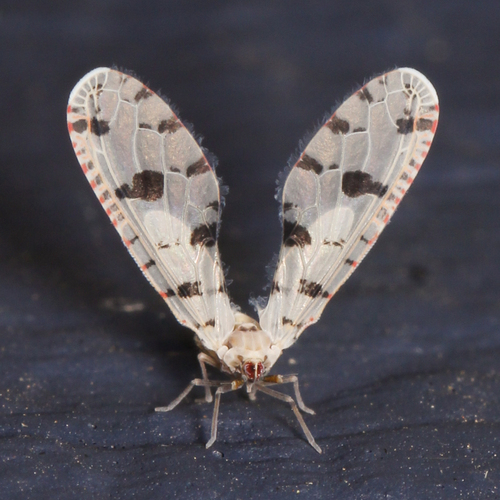
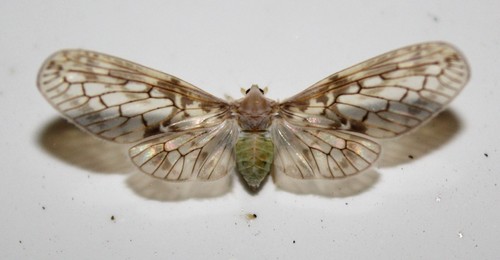
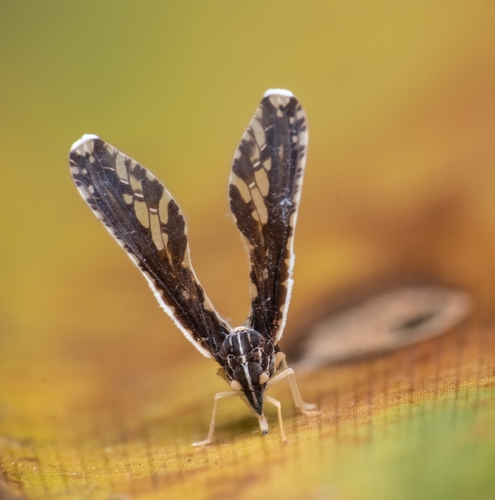
Proutista moesta is one of the smaller species in the genus Proutista. When measured from the tip of the head to the end of the abdomen, its body is around 3 mm long, and its forewings measure about 6 to 6.5 mm in length. On average, females are roughly 10% larger than males. For specimens from Taiwan measured from the tip of the head to the end of the forewings, males range from 6.8 to 7.0 mm and females from 7.4 to 7.8 mm. For the forewings alone, males measure 6.1 to 6.2 mm and females 6.5 to 6.8 mm in this Taiwan sample. Like other species in the genus Proutista, the media vein of the forewing has 6 branches that do not split further into sub-branches. The hindwings are approximately half as long as the forewings and have rounded tips. The forewings have a club-shaped outline, with a narrow base that widens abruptly into an unusually broad distal section. The frons (face) is narrow, and the facial ridges meet in front of the eyes. Proutista moesta is predominantly black, with only the legs, antennae, upper parts of the facial ridges, and rostrum showing a yellowish to light orange color. The mesoscutellum, and ridges on the mesonotum, abdomen, and clypeus are whitish to light yellow or orange. Abdominal segments have rows of white dots, and the rest of the body also has small scattered white markings. The black forewings have a whitish outer margin, whitish tips, and clear patches along the costal margin, as well as in the distal half between the hind margin and the media vein. The black hindwings have clear patches along the hind margin. When at rest, P. moesta holds its wings raised above the body, spread at an angle of approximately 60 degrees. Proutista moesta is the most common species of the genus Proutista found in Asia. Its distribution extends from Tanzania in eastern Africa, across the Seychelles and Maldives in the Indian Ocean, to India and Sri Lanka. The only existing African record is thought to possibly represent a new introduction. Further east, the species has been reported from southern mainland Asia including Bangladesh, Malaysia, Thailand, Vietnam, and southern China, as well as multiple islands in the western Pacific. This range apparently covers most of Indonesia, plus the Philippines, Taiwan, Guam, Palau, and New Guinea. There are also records from Japan, parts of the Northern Marianas (Tinian, Rota), and parts of the Federated States of Micronesia (Losap Atoll, Nomwin Atoll). In his original 1851 description, Westwood named eastern India ("India orientali") as the type locality. For the species now considered synonyms of P. moesta, the respective type localities are Assam (northeastern India) for Assamia dentata, Flores (Indonesia) for Thracia albipes, and Java (Indonesia) for Phenice maculosa.