About Protoxerus stangeri (Waterhouse, 1842)
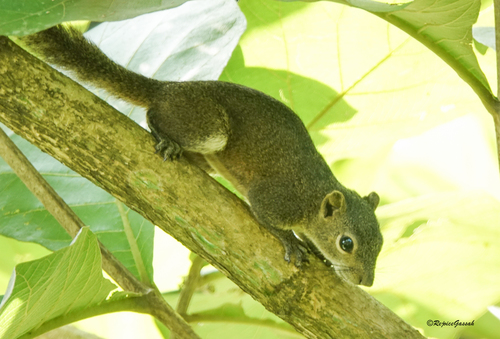
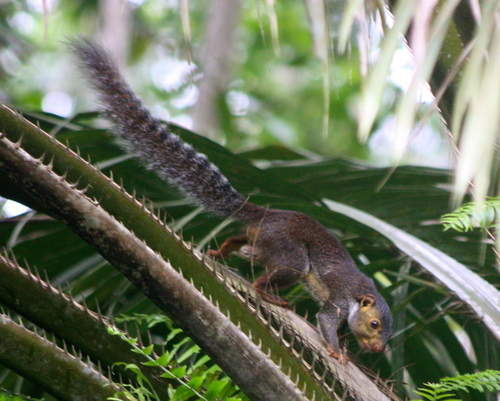
The forest giant squirrel (Protoxerus stangeri (Waterhouse, 1842)) is the largest arboreal squirrel in Africa. It has a head-and-body length of around 300 mm (12 in), with a bushy tail of a similar length. It has a large, rounded head and powerful cheek muscles. Brownish hairs on the top of the head and nape are tipped with white, giving a frosted appearance. Its ears are small, rounded, and almost hairless. Body colouring is rather variable across its wide range. The fur is short and stiff; the upper parts of the body are medium brown grizzled with buff or yellow, with individual hairs having black bases, yellow or buff shafts, and black tips. The chest is white, and the underparts are almost hairless, showing yellowish skin underneath. The limbs are compact and strong. The upper side of the long, bushy tail has broad transverse black bars and narrow white bars, while the underside has equal-sized longitudinal black and white stripes. The tail’s black and white barring is sometimes not clearly visible. When the squirrel is moving, it holds the tail horizontally, but when it is stationary, the tail hangs down. The tail is used for signalling, and the signal differs when the tail is displayed upwards versus when it is displayed downwards. This species is native to tropical western and central Africa. Its range extends from Sierra Leone to western Kenya, and southwards to northern Angola and northern Tanzania. It is a lowland species with a maximum altitudinal limit of about 2,000 m (6,600 ft). It occurs in primary forest, secondary forest, fringing forest, as well as plantations, agricultural land, and gardens with trees. It is normally found in the upper layers of the canopy, only occasionally descending to ground level. The forest giant squirrel is solitary and diurnal. It forages primarily for the fruits and seeds of trees and lianas, and can crack open the tough nuts of *Panda oleosa*, *Coula edulis*, *Klainedoxa gabonensis*, *Elaeis*, and *Irvingia* spp. Its diet also includes some other plant material, and a very small proportion of insects. The squirrel has a home range of a few hectares and seems to avoid other squirrels or drive them away from a tree where it is feeding. Its vocalisations include two types of alarm calls. This squirrel is preyed on by eagles and other large birds of prey. Its nest is built inside a tree cavity with an entrance the squirrel can just fit through. Nesting material consists of twigs that still have their green leaves attached. The squirrel emerges around dawn and returns to the nest many hours later. The reproductive behaviour of this squirrel has not been studied, but it usually has litters of one or two young.