About Protoreaster nodosus (Linnaeus, 1758)
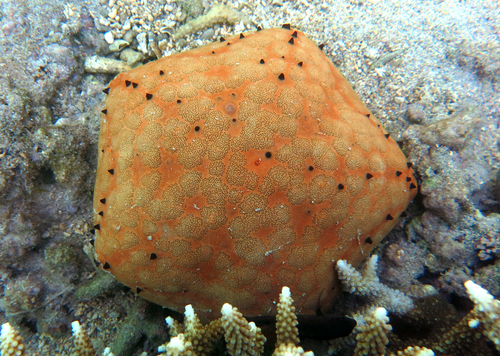
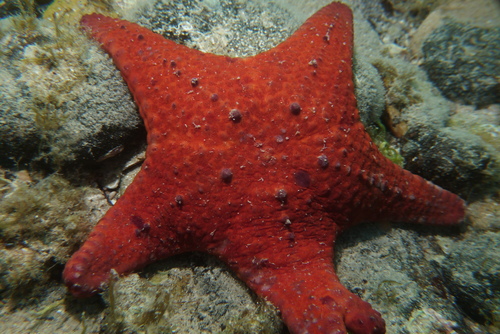
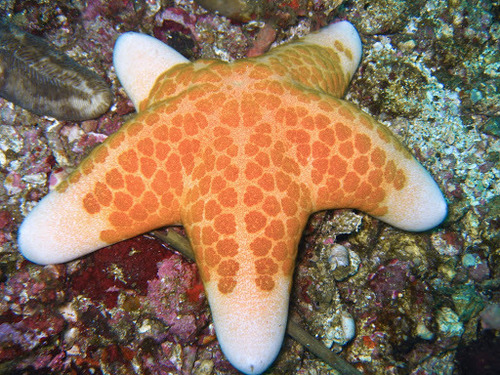
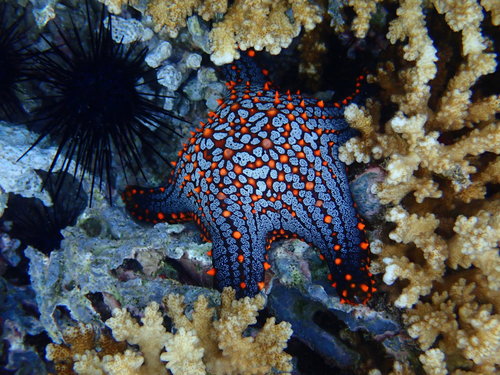
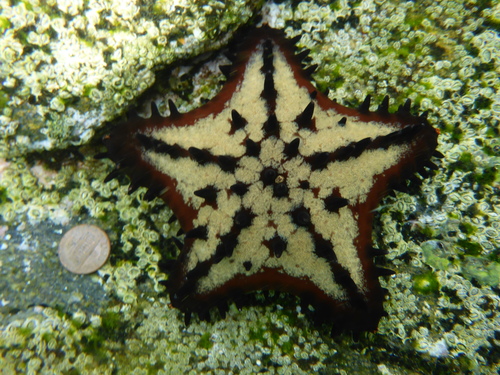
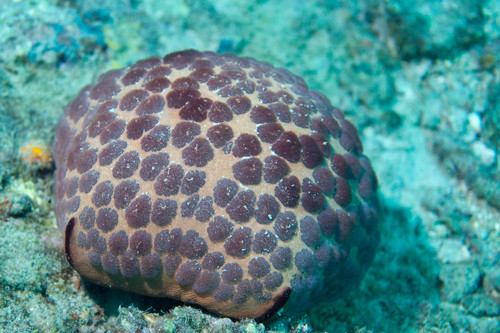
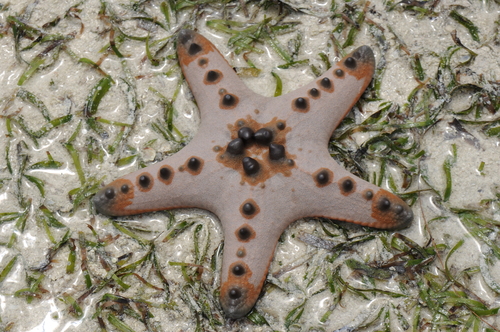
Protoreaster nodosus, commonly called the horned sea star, has rows of spines, or "horns," on its dorsal (upper) side: these are black conical points arranged in a single radial row, and they may erode over time to become blunt. These dark protrusions help intimidate potential predators by appearing frightening or dangerous. On its ventral (lower) side, purple or pale transparent pink tube feet are arranged in rows along each arm. Most wild horned sea stars have a rigid, roughly five-pointed star shape with tapering arms, though anomalous specimens with four or six arms do occur. The species can grow up to 30 centimetres (12 inches) in diameter. Individuals are most commonly coloured in shades of red or brown, but may also be light tan with a colour similar to cookie dough. This colouration, combined with the small dorsal horns, gives the sea star an appearance similar to a chocolate chip cookie. Horned sea stars prefer sheltered, sandy or slightly muddy bottoms over hard substrates such as coral reef. They are frequently seen openly between the leaves of seagrass in seagrass meadows, or on open stretches of coral sand. Field studies indicate this species is restricted to the western Pacific Ocean, ranging from Thailand to Samoa, and from Japan to New Caledonia. In shallow areas, this species can be found in the intertidal zone, and is occasionally exposed during low tide. It does not tolerate rapid environmental changes well, and usually stays submerged. Many individual horned sea stars can often be found gathering on soft seabeds. While the cause of this gathering is mostly unknown, it is thought to either increase the chance of successful fertilization during spawning, or simply occur because the area is a good feeding ground. Horned sea stars are opportunistic carnivores. In aquariums, adults are known to prey on most sessile life forms including hard corals and sponges, and will also hunt snails for food. One wild horned sea star has been observed eating a sea urchin in its natural habitat. Like other tropical echinoderms, commensal animals including shrimp of the genus Periclimenes, tiny brittle stars, and even juvenile filefish can be found living on the surface of a horned sea star. This association is likely due to the protection the sea star provides, as horned sea stars have few natural predators.