About Protonectarina sylveirae (de Saussure, 1854)
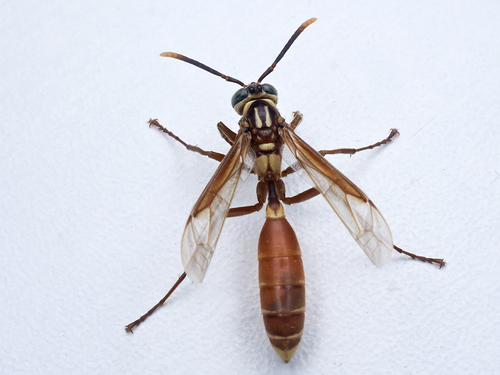
The wasp genus Protonectarina, and its species Protonectarina sylveirae, is characterized by relatively hairy eyes, and can be identified by the width of the clypeus, the front section of the head. Compared to workers, queens have a lighter-colored body and a wider clypeus region marked with brown spots. The clypeus of workers has a black, horseshoe-shaped marking that differs widely between individual workers. Queens are typically larger than workers, but this size difference varies between colonies; a queen can even be the same size as the workers in its own colony. The age of an individual P. sylveirae can be determined from the pigmentation of the transverse apodeme that crosses the hidden base of the fifth sternum. As a wasp gets older, pigment gradually accumulates in this region, causing it to darken. P. sylveirae has a wide distribution that ranges from Brazil to Argentina. This species builds its nests in trees, usually suspended from twigs. Nests are made from foraged cellulose that is mashed together with water to form a papery substance used to build nest walls. Cylindrical nests are built as a series of overlapping enclosing envelopes. When constructing a nest, the first envelope is built directly on the substrate, and each additional envelope is added to the existing base. The seams between nest cells are characteristically irregular, and a simple entrance is built on the ventral surface of the completed nest structure. An average P. sylveirae nest contains around 50 combs, but nests can grow quite large, sometimes reaching 30 to 40 centimeters in length. P. sylveirae is a swarm-founding wasp species, and it sends multiple individuals out to forage for pulp; the colony constructs its nest from the material that these pulp-foraging wasps bring back.