About Protographium marcellus (Cramer, 1777)
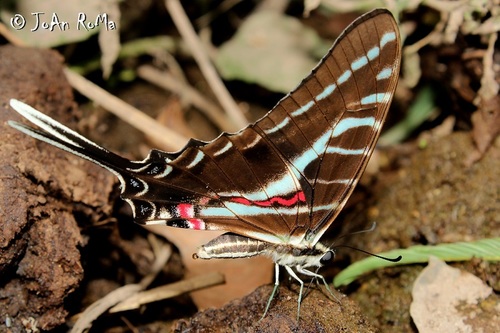
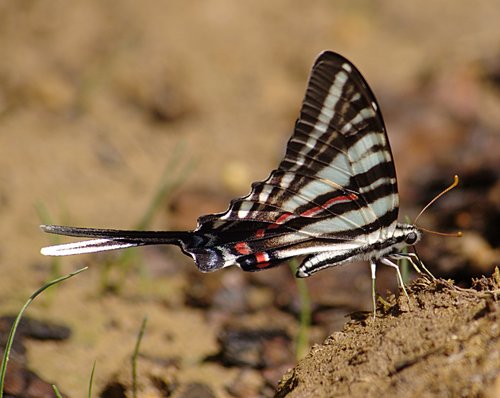
The zebra swallowtail (Protographium marcellus) has a wingspan ranging from 6.4 to 10.4 cm (2.5 to 4.1 inches). Its triangular wings are white to greenish-white, marked with black longitudinal stripes. A pair of sword-like tails extends from its hindwings. On the inner margin of the hindwing, there are two blue spots at the corner and one red spot close to the body. A red stripe runs along the center of the ventral surface of the hindwing. This species has two distinct seasonal forms: one that appears in spring and another that appears in summer. Spring forms are smaller, more predominantly white, and have short black tails with white tips. Summer forms are larger, have broader black stripes, and have longer black tails with white edges. Because its caterpillars are cannibalistic, female zebra swallowtails lay their eggs one at a time on pawpaw leaves or tree trunks. Newly laid eggs are round and pale green, and turn orange brown as they develop. Young caterpillars are black with lighter transverse stripes. Older larvae have two different color forms. The more common older larva is green with yellow and white transverse stripes, while the rarer form is black with white and orange bands. In both color forms, a yellow, black, and bluish-white band sits between the swollen thorax and the abdomen. The larva has a yellow, foul-smelling, forked gland called an osmeterium that it uses to deter predators, most commonly spiders and ants. The chrysalis of the zebra swallowtail can be either green or brown, and it is more compact than chrysalids of species in the genus Papilio. Three small horns project from the chrysalis's head and thorax. In parts of the species' range that have cold winters, the chrysalis hibernates through the cold season.