About Protobothrops mucrosquamatus (Cantor, 1839)
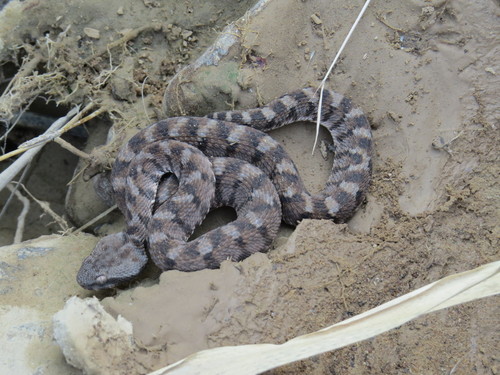
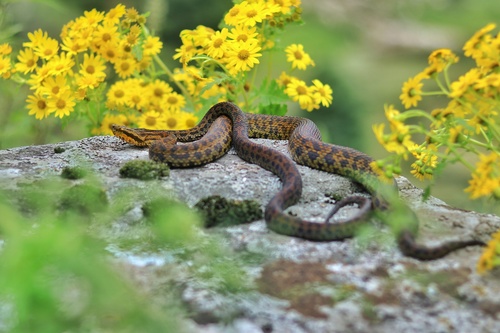
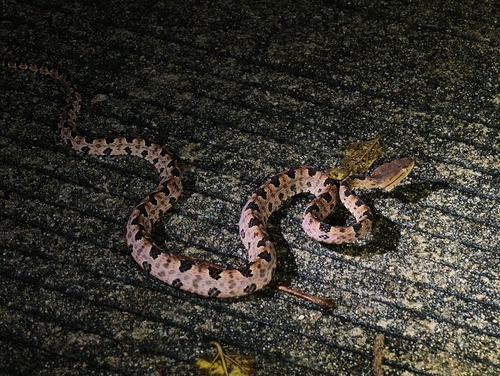
This species, Protobothrops mucrosquamatus (Cantor, 1839), has the following size characteristics. Males reach a maximum total length of 112 cm (44 in), with a tail length of up to 19.5 cm (7.7 in). Females reach a maximum total length of 116 cm (46 in), with a tail length of up to 20.5 cm (8.1 in). The species' hemipenes are spinose. Details of its scalation are as follows: dorsal scales are arranged in 25 longitudinal rows at midbody. Scales on the upper surface of the head are small, and each scale is keeled on its posterior portion. Internasals are 5 to 10 times the size of adjacent scales, and are separated by 3 to 4 scales. Supraoculars are long, narrow, and undivided; there are 14 to 16 small interoculars in the line between the two supraoculars. There are 2 scales on the line between the upper preocular and nasal scale. There are 9 to 11 upper labials; the first upper labial is separated from the nasal by a suture. There are 2 to 3 small scales between the upper labials and subocular. There are 2 to 3 rows of temporal scales above the upper labials that are smooth, and the scales above these temporal rows are keeled. Ventrals number between 200 and 218. Subcaudals number between 76 and 91, and all are paired. Its color pattern is as follows: the dorsal surface is grayish or olive brown, with a dorsal series of large brown spots or blotches that have black edges, plus a lateral series of smaller spots. The upper surface of the head is brownish, while the lower surface of the head is whitish. The belly is whitish but heavily speckled with light brown powder. The tail is brownish, and may be pink when alive according to M.A. Smith 1943:507; it also has a series of dark dorsal spots. Its geographic range extends from northeastern India (Assam and Mizoram) and Bangladesh, east to Myanmar, China (including Hainan, reaching as far north as Gansu and as far east as Zhejiang), Laos, northern and central Vietnam. It is also found in northern Thailand and in Taiwan. The species' type locality is the Naga Hills, India. This snake has been introduced to Okinawa, Japan.