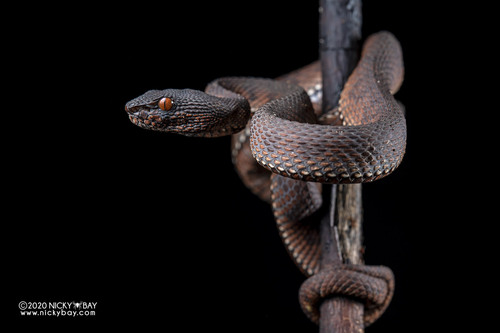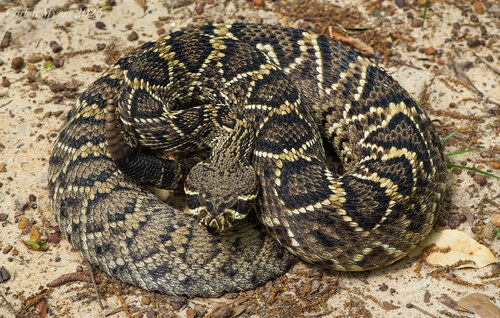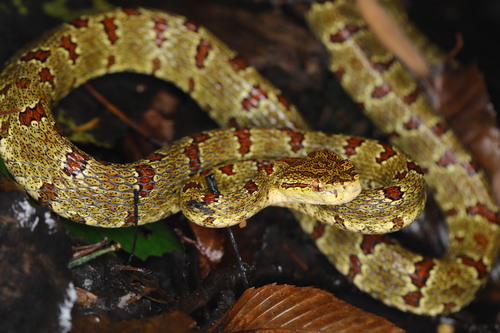
About Protobothrops jerdonii (Günther, 1875)
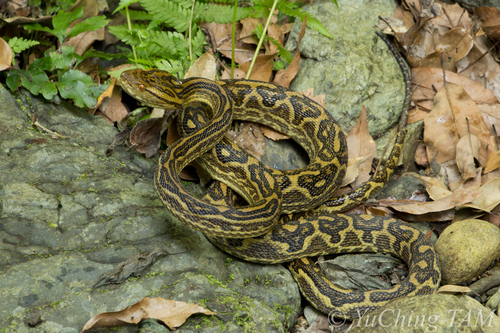
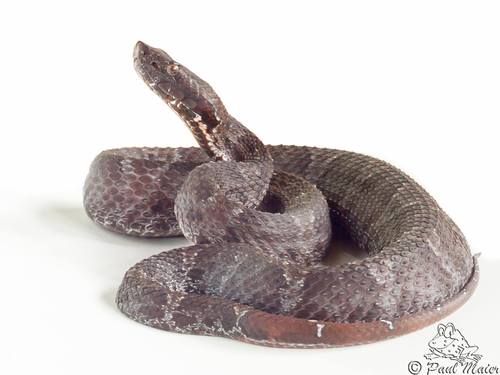
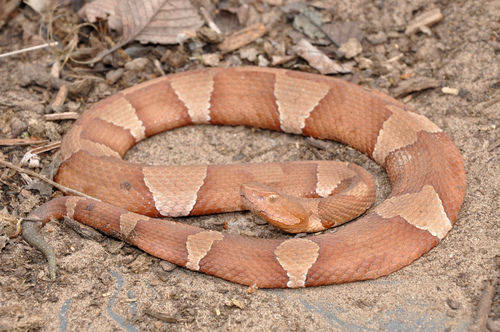
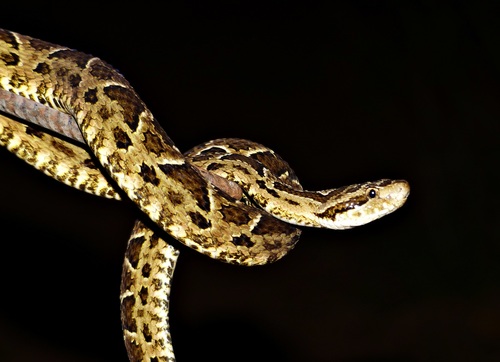
Male Protobothrops jerdonii reach a maximum total length of 835 mm (32.9 in), with a tail length of up to 140 mm (5.5 in). Females of this species grow to a maximum total length of 990 mm (39 in), with a tail length of up to 160 mm (6.3 in). In terms of scalation, this species has 21 longitudinal rows of dorsal scales at midbody, with 23 rows occurring rarely. The length of the snout is slightly more than twice the diameter of the eye. The top of the head is covered in small, unequal, smooth scales that are weakly overlapping or positioned side by side, with the exception of the large internasal and supraocular scales. The first upper labial scale is fully separated from the nasal scale by a suture. The internasals are separated by 1 to 2 small scales. There are 6 to 9 small scales in a line between the two supraoculars. This species has 7 to 8 upper labials; the third and fourth are positioned under the eye, and are either in contact with the subocular, or separated by no more than a single row of small scales. Male P. jerdonii have 164 to 188 ventral scales, while females have 167 to 193. Male P. jerdonii have 50 to 78 subcaudal scales, and females have 44 to 76. Protobothrops jerdonii has a geographic range that extends from northeastern India and Nepal, through northern Burma, to southwestern China and Vietnam. The type locality given by the original describer Günther is "Khassya", which corresponds to the Khasi Hills in India. The preferred natural habitats of P. jerdonii are forest, shrubland, and grassland, found at altitudes between 1,400 m and 2,300 m (4,600 ft to 7,500 ft). Reports have described the reproductive mode of P. jerdonii as both viviparous and ovoviviparous. Litters of this species contain five to eight newborn individuals.