About Protobothrops flavoviridis (Hallowell, 1861)
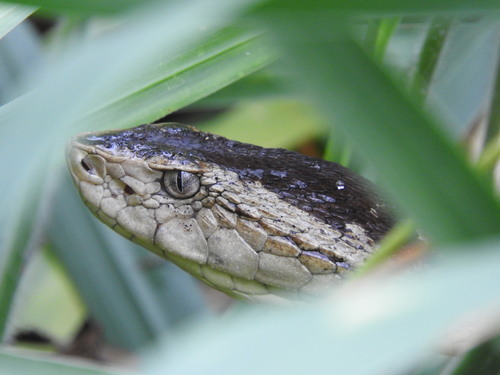
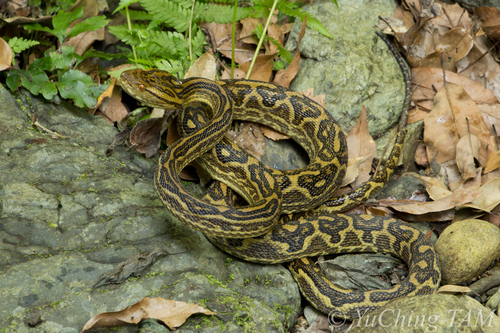
Description: This species grows to an average total length of 4–5 feet (120–150 cm), and reaches a maximum of 7.9 feet (240 cm), making it the largest member of its genus. It has a slender build, graceful proportions, and a large head. The crown of its head is covered with small scales. P. flavoviridis has a light olive or brown base color, patterned with elongated dark green or brownish blotches. These blotches have yellow edges, sometimes contain yellow spots, and often fuse to form wavy stripes. Its belly is whitish with dark coloring along the edges. Distribution and habitat: Commonly called the Okinawa habu, this species is found only in the Japanese Ryukyu Islands, including Okinawa and the Amami Islands. Its type locality is "Amakarima Island (one of the Loo-Choo group)" which corresponds to Keramashima, Ryukyu Islands. It is common on larger volcanic islands in the region, but does not occur on smaller coral islands. It is most often found in the transition zone between palm forest and cultivated fields. It can also be found on rock walls, and inside old tombs and caves. Ecology: The Okinawa habu is a terrestrial species that is mostly active at night. It often enters homes and other structures to hunt for rats and mice. It is bold and irritable, capable of striking quickly with a long striking reach. Unlike most pit vipers, the habu is oviparous, meaning it lays eggs instead of giving birth to live young. Mating occurs in early spring, and females lay up to 18 eggs in mid-summer. After an incubation period of 5–6 weeks, the hatchlings emerge. These hatchlings are 25 cm (10 in) long and look identical to adult individuals. In 1910, the small Indian mongoose (Herpestes javanicus) was introduced to the island of Okinawa to reduce the local P. flavoviridis population. While the effects of this specific introduction have not been studied, similar introductions have caused documented negative impacts on native bird, mammal, and herpetofauna species, a situation that concerns wildlife managers. Use by humans: On the island of Okinawa, this species is heavily collected primarily to make habushu (Okinawan snake liquor). Habushu is made with awamori, a local Okinawan distilled liquor, that is claimed to have medicinal properties. As is common for snake wine, the snakes may be placed into the storage container while still alive and left to drown, or they may be stunned first and gutted while still alive. The snake's whole body is included during the fermentation process, and the finished product is sold in bottles that may or may not still hold the snake's body, alongside or without other animals like lizards or scorpions.