About Proteus anguinus Laurenti, 1768
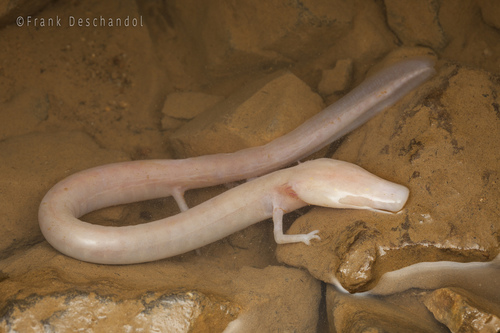
The olm (pronounced [ɔlm] in German), also called proteus, has the scientific name Proteus anguinus. It is an aquatic salamander, and the only species in the genus Proteus of the family Proteidae. It is also the only exclusively cave-dwelling chordate species found in Europe; the only other extant genus in the Proteidae family is Necturus. Unlike most amphibians, the olm is entirely aquatic—it eats, sleeps, and breeds all underwater. It lives in caves of the Dinaric Alps, and is endemic to underground water flowing through the extensive limestone karst bedrock of Central and Southeastern Europe, specifically in the Soča River (Isonzo in Italian) basin near Trieste (Italy), southern Slovenia, southwestern Croatia, and Bosnia and Herzegovina. There are also introduced populations near Vicenza, Italy, and Kranj, Slovenia. The olm was first documented in 1689, when local naturalist Valvasor mentioned it in his work *Glory of the Duchy of Carniola*. He recorded that after heavy rains, olms would be washed out from underground waters, and local people believed they were the offspring of a cave dragon. This cave salamander is most well known for its adaptations to living in complete darkness in its underground habitat. Its eyes are underdeveloped, leaving it blind, but its other senses—especially smell and hearing—are highly developed. Most olm populations also have no pigmentation in their skin. Olms have three toes on their forelimbs, but only two toes on their hind feet. They exhibit neoteny, retaining larval features like external gills into adulthood, similar to some North American amphibians including the axolotl and mudpuppies (genus Necturus).
Regarding its ecology and life history: the olm lives in well-oxygenated underground waters with a very stable typical temperature of 8–11 °C (46–52 °F), and rarely reaches as warm as 14 °C (57 °F). Observations in northeastern Italy have recorded olms swimming to the surface in springs outside of caves, even in daylight, where they occasionally feed on earthworms. The black olm variant may live in slightly warmer surface waters. Olms swim with eel-like twisting of their body, with only minor assistance from their underdeveloped legs. They are predatory, and feed on small crustaceans (including *Troglocaris* shrimp, *Niphargus*, *Asellus* and *Synurella* amphipods, and *Oniscus asellus*), snails (such as *Belgrandiella*), and occasionally insects and insect larvae (including caddisflies, mayflies, stoneflies, and flies/ mosquitoes). They do not chew their food—instead, they swallow it whole. The olm is resistant to long-term starvation, which is an adaptation to its underground habitat. It can eat large amounts of food in one meal, and stores nutrients as large deposits of lipids and glycogen in the liver. When food is scarce, it reduces its activity level and metabolic rate, and can even reabsorb its own body tissues in severe cases. Controlled experiments have shown that an olm can survive up to 10 years without food. Olms are gregarious, and typically aggregate together under stones or in rock fissures. Sexually active males are an exception, as they establish and defend territories to attract females. Because food is scarce, fighting is energetically costly for olms, so encounters between males usually only involve display behavior. This is a behavioral adaptation to life underground.