About Proteodes profunda Meyrick, 1905
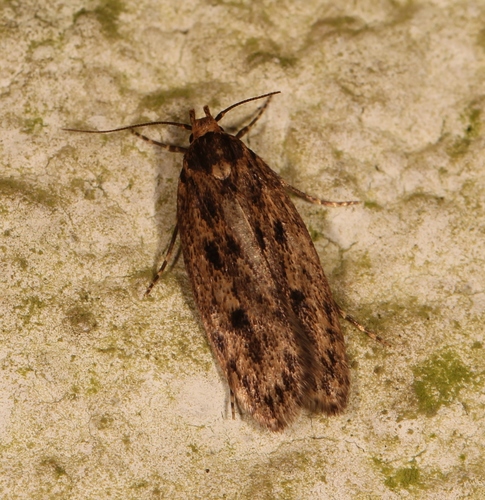
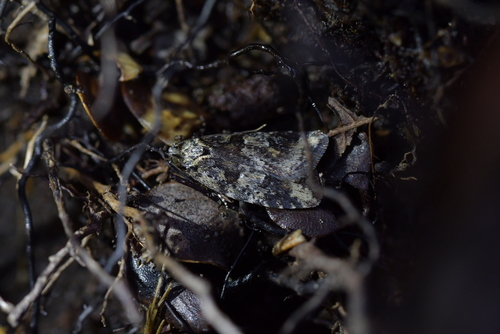
Male Proteodes profunda Meyrick, 1905 measures 20 mm. Its head is ochreous, mixed with dark fuscous on the sides. Palpi are dark fuscous, with the extreme apex of the second and terminal joints pale ochreous. Antennae are fuscous. The thorax is dark fuscous, partially mixed somewhat with whitish-ochreous. The abdomen is dark fuscous mixed with ochreous-whitish, and has a pair of oblique narrow bladder-like membranes on the upper side at its base. Fore-wings are broad and suboblong, rather dilated towards the posterior; the costa is moderately arched, the apex obtuse, the termen faintly sinuate, only slightly oblique, and rounded beneath. Fore-wings are fuscous, with a series of cloudy dots of black irroration on the veins. Markings on the fore-wings are formed by whitish-ochreous suffusion, irregularly sprinkled with dark ferruginous. There are about six irregular subconfiuent spots towards the base and the anterior half of the costa. A triangular subterminal patch extends from the apex to the tornus, leaving a narrow terminal streak of the ground colour, with its apex extending inwards to the lower angle of the cell. Small discal spots of blackish suffusion are present before and beyond the middle of the fore-wing. Cilia are whitish-fuscous, with the basal half mixed with dark fuscous and whitish-ochreous, and have four pale dots on the costa. Hind-wings are grey, with whitish-grey cilia. This species is very similar in superficial appearance to species in the Tortricidae family, and mimics a dead beech leaf. Hudson regarded it as rare. This species is endemic to New Zealand. It has been collected at its type locality of Mount Holdsworth in the Tararua Range, Raurimu near Tongariro National Park, Days Bay in Wellington, Mount Arthur, Otira, Invercargill, and in Southland. P. profunda inhabits beech forests at altitudes of around 2000 ft. The larvae of this species feed on beech tree leaves.