About Proteles cristata (Sparrman, 1783)
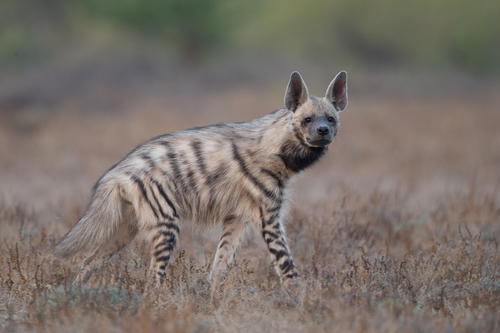
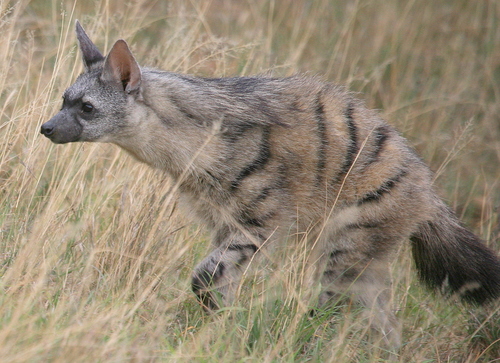
This species, the aardwolf, scientific name Proteles cristata (Sparrman, 1783), resembles a much smaller, thinner version of the striped hyena. It has yellowish fur marked with black vertical stripes, a more slender muzzle, and a long, distinct mane running down the midline of its neck and back. It also has one or two diagonal stripes across its fore and hindquarters, plus additional stripes on its legs. When the aardwolf is in a confrontation, it raises its mane to make itself appear larger. Unlike other members of its family, it lacks a dark spot on its throat. The portion of its lower leg below the knee is entirely black, and it has a bushy tail with a black tip. Excluding its bushy tail, the aardwolf measures 55 to 80 cm (22 to 31 in) in body length; its tail adds an extra 20–30 cm (7.9–11.8 in) in length. It stands roughly 40 to 50 cm (16 to 20 in) tall at the shoulders. Adult aardwolves weigh approximately 7–10 kg (15–22 lb), and can sometimes reach up to 15 kg (33 lb). Aardwolves from southern Africa tend to be slightly smaller, averaging around 10 kg (22 lb), than eastern aardwolves, which average around 14 kg (31 lb). This makes the aardwolf the smallest living member of the Hyaenidae family. Each of its front feet has five toes, unlike the four toes found on other hyenas. Its skull shares a similar shape with the skulls of other hyenas, but is much smaller, and its cheek teeth are specialized for eating insects. It still retains canines, but unlike other hyenas, it uses these teeth primarily for fighting and defense. Its large ears are very similar in shape to those of the striped hyena. As an aardwolf ages, it will typically lose some of its teeth, but this has little impact on its feeding habits because the insects it eats are soft. Aardwolves inhabit open, dry plains and bushland, and avoid mountainous areas. Because of their specific food requirements, they are only found in regions where termites of the family Hodotermitidae live. Termites in this family feed on dead, withered grass, and are most abundant in heavily grazed grasslands, savannahs, and agricultural farmland. For most of the year, aardwolves live in shared territories that contain up to a dozen separate dens, with each den occupied for around six weeks at a time. There are two separate wild populations of aardwolf: one in Southern Africa, and another in East and Northeast Africa. The species is not found in the miombo forests that lie between these two population ranges. An adult pair of aardwolves, along with their most recent offspring, occupies a territory that covers 1–4 km2 (0.39–1.54 sq mi). Aardwolves are shy, nocturnal animals, and sleep in underground burrows during the day. Occasionally, in winter, they will switch to feeding during the day. This shift occurs during the coldest periods of the season, when they stay in their burrows at night to conserve body heat. They are primarily solitary animals, but during the mating season they form monogamous pairs that occupy a territory together with their young. If another aardwolf infringes on a pair's territory, residents will chase the intruder away for up to 400 m (1,300 ft) or all the way to the territory border. If the intruder is caught, which happens rarely, a fight will break out, accompanied by soft clucking sounds, hoarse barking, and a specific type of roar. Most territorial incursions happen during mating season, when they can occur once or twice per week. When food is scarce, the strict territorial system may be abandoned, and up to three pairs may share a single territory. Both male and female aardwolves mark their territory. Both sexes have well-developed anal glands that produce a black substance, which the aardwolf smears onto rocks or grass stalks in 5-millimetre (0.20 in) long streaks. Aardwolves also have scent glands on their forefoot and penile pad. They often mark near termite mounds inside their territory about every 20 minutes. When patrolling their territorial boundaries, marking frequency increases drastically, to one mark every 50 m (160 ft). At this rate, an individual aardwolf can leave 60 marks per hour, and more than 200 marks per night. An aardwolf pair's territory can hold up to 10 dens, plus numerous middens, where they dig small holes and bury their feces with sand. Their dens are usually abandoned dens originally dug by aardvarks, springhares, or porcupines; occasionally, they use natural rock crevices as dens. They will also dig their own dens, or enlarge existing dens started by springhares. They typically use only one or two dens at a time, and rotate through all of their dens every six months. During the summer, they may rest outside their den at night, and sleep underground during the hot daytime. Aardwolves are not fast runners, and they are not particularly skilled at fighting off predators. For this reason, when threatened, an aardwolf may try to confuse its predator by doubling back along its own previous tracks. If directly confronted, it can raise its mane to try to appear more menacing. It also releases a foul-smelling liquid from its anal glands when threatened.