About Protea gaguedi J.F.Gmel.
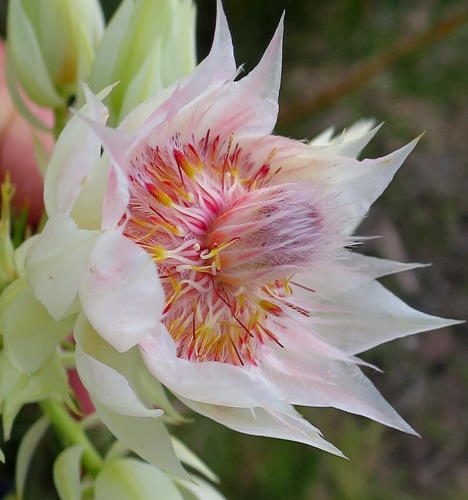
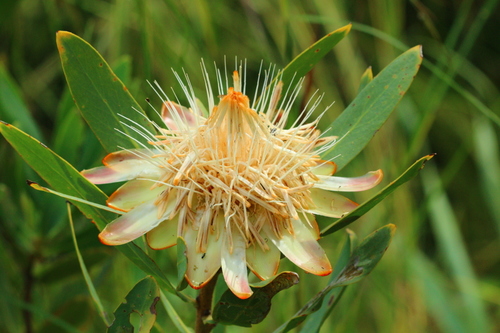
Protea gaguedi J.F.Gmel. typically grows as a small, erect to gnarled tree, reaching a maximum height of three metres. Its leaves are oblong to elliptic, and often have a distinct sickle shape. Mature leaves are glabrous (hairless), with the exception of a small number of hairs near the base of the leaf blade. Leaf colour ranges from light green to blue-green, and the prominent leaf midrib has a slightly yellowish colour. This species usually produces solitary flower heads, which are a specialized form of inflorescence. The flower heads vary quite a bit in shape, and can grow up to 11 centimetres in diameter. They are densely hairy and give off a very strong scent. The outer involucral bracts range in colour from pink to greenish-white to white. The inner bracts are pale green and covered in silver hairs. Rusty-coloured hairs may or may not grow along the margins of the bracts. The fruit this species produces is a hairy nutlet. This species is widely distributed across Africa, ranging from Eritrea in the north to KwaZulu-Natal in South Africa. It is not found in the Sahel region of West Africa. Countries where it grows include Sudan (including South Sudan), Eritrea, Ethiopia, Burundi, Rwanda, Uganda, Kenya, Tanzania, the Democratic Republic of Congo, Zambia, Angola, Botswana, Zimbabwe, Malawi, Mozambique, Namibia, eSwatini, and South Africa. In South Africa, it is widespread across the northern part of the country, and can be found in Gauteng, KwaZulu-Natal, Limpopo, Mpumalanga, and North West Province. It occurs in a variety of habitats, and most often grows on rocky ground.