About Protea dracomontana Beard
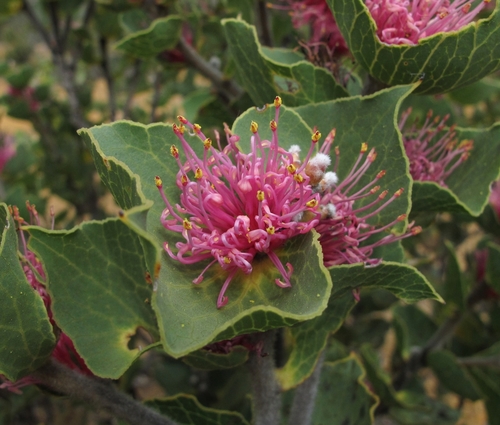
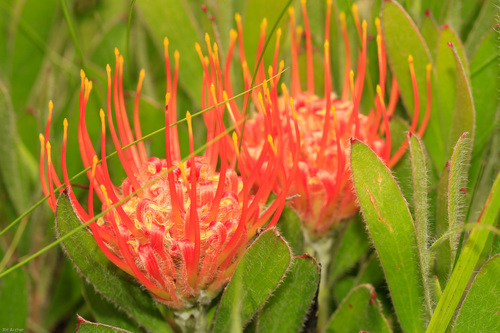
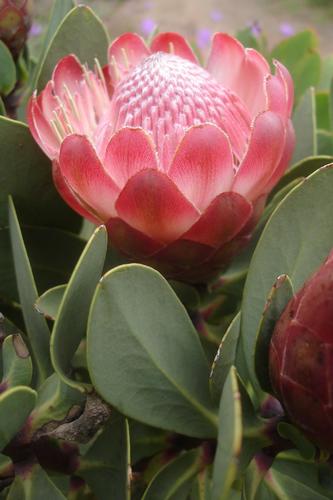
Protea dracomontana Beard is a shrub that grows multiple stems, reaching up to 1.5 metres tall, and is often shorter. It blooms primarily from January to March. This species is monoecious, meaning each individual flower contains both male and female reproductive parts. Its flowers are clustered into a tightly packed inflorescence, called a flower-head, that is surrounded by petal-like bracts. The flower-head is 6–9 cm in diameter, creamy-white in color, and often tinged pink at the tips of the innermost bracts and the flowers. The stems are reddish-brown to grey, glabrous, and smooth to the touch. It is extremely similar to Protea afra subsp. gazensis found in Zimbabwe and Protea afra subsp. afra found in South Africa, both of which grow at lower altitudes than P. dracomontana. P. dracomontana can be primarily distinguished from these two taxa by its shorter inflorescences and short, squat, bushy growth form. Rourke (1980) notes that possible hybrids between P. dracomontana and these taxa may exist. In ecological terms, this species can re-sprout after wildfires from a woody bole-shaped rootstock. However, it appears to require some protection from wildfires, and is always found growing among rocks. Pollination is carried out by birds and insects. The species does not store seeds on the plant; seeds are released 9 to 12 months after flowers form, and are dispersed by wind. In South Africa, P. dracomontana grows in alpine grasslands and among rocky outcrops at altitudes between 1,600 m and 2,200 metres. In Zimbabwe, it grows in peaty tussock grassland at altitudes of 2,300 to 2,400 metres, and possibly higher, on the summit of a single mountain.