About Protea angustata R.Br.
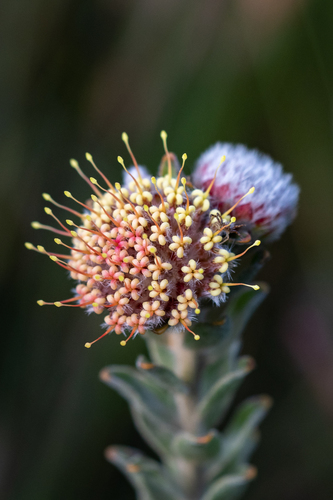
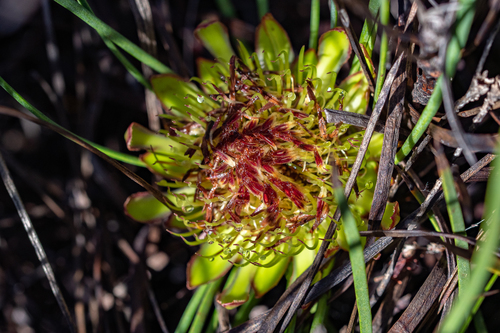
Protea angustata R.Br. is a small dwarf shrublet that grows up to 35 cm tall. Over time, it develops an extensive underground mat up to 1.5 metres across, with sparse tufts of leaves emerging above the soil surface. This species is very cryptic and difficult to spot, as it is both rare and easily concealed among similar-looking restios. Because most of the plant grows below ground, it is well protected from the wildfires that occasionally burn through its native habitat. It has a thick, woody rootstock that produces many branching underground stems. Thanks to its ability to re-sprout after wildfires, mature shrubs persist at high rates in isolated remnant habitats, and individuals are thought to live for more than a century, with a generation length over 100 years. When cultivated, shrubs do not produce blooms until their seventh year. The leaves are very long and narrow, helping them blend into the reed-like ground vegetation of the species' habitat. Leaves are smooth, hairless (glabrous), and curve upwards; they measure 12 to 25 cm in length and 2 to 8 mm in width. They are typically flat, but may sometimes have in-rolled margins. Each leaf has a pointed tip, and the base (where the leaf attaches to the stem) tapers gradually in width up to the leaf's broadest section. The species blooms from July to October, with peak bloom occurring in early September. It produces just a few small, greenish-cream flower heads close to ground level. Flower heads grow laterally on stems, rather than at the tips (so leaves grow above the flower heads), and are cup-shaped, reaching 3 to 4.5 cm wide. This measurement includes the 22–28 mm long bracts, which are creamy green to apple green and surround the actual flowers. The upper margins of the bracts are tipped with velvety brown hairs. The flowers are narrow and tubular. P. angustata is monoecious, with both male and female reproductive structures in each flower. Blooming plants give off a strong yeasty smell. Even when cultivated, plants do not flower every year, and most years a plant produces only two or three flower heads. Seeds are stored in a capsule held within the woody, dried, fire-resistant inflorescence, which remains attached to the plant after it matures (it is persistent). Seeds are released one to two years after flowering, when wildfires trigger the fruits to open, and are dispersed by wind. This species is endemic to the Western Cape province of South Africa. It has a restricted distribution, growing along a narrow coastal band in the southwestern Cape Region, usually occurring no more than 5 km inland from the sea. Around 50% of the total global population is found near Brightwater, Cape Town, which is the largest population. The three largest populations are located in Pringle Bay, Onrusrivier and Kleinmond, all areas near Cape Town that are currently undergoing rapid urban development. Only a small number of plants grow east of Hermanus; the majority of the global population occurs from Hermanus westward to Pringle Bay. It is also found from the Kogelberg mountains across to the Groenland mountains and Kleinrivier mountains, with somewhat isolated populations growing on the Caledon Swartberg. Individuals are typically spaced apart, and not found growing near one another. It occurs on the southern foothills of coastal mountains, growing on coastal-facing flats and gentle slopes in both sand and clay soils. It most often grows in deep, white, sandy soils within fynbos habitat, but the population at Kleinmond grows in coastal brush on shale-derived soils. It grows in a temperate climate where most rainfall occurs in winter, at altitudes ranging from sea level to 180 metres. Pollination is thought to be carried out by mice, rats, birds, and/or insects. One source states that mice are the most likely pollinators, based on the flower's characteristic yeasty smell, low position close to the ground, and lack of showy colouration to attract birds or insects. One source claims periodic wildfires kill adult plants but leave seeds unharmed, but two other sources clarify that this is a long-lived species where only above-ground plant parts are killed by fire. The species survives fires by re-sprouting from its thick rootstock and underground stems, and fire actually appears to stimulate new growth. Flowers usually develop three years after a fire passes through an area. Without fire, plants become weaker and produce fewer flowers and less seed, a condition that is easily reversed after a fire.