About Prosthemadera novaeseelandiae (J.F.Gmelin, 1788)
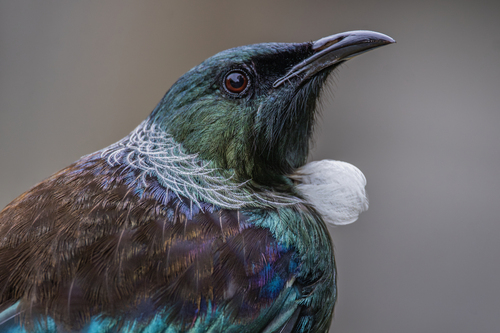
Prosthemadera novaeseelandiae, commonly known as the tūī, is a large honeyeater. Adults range from 27 to 32 cm (11–13 in) in length. The subspecies native to the Chatham Islands is, on average, larger and heavier than the nominate subspecies, and males of all populations tend to be heavier than females. Nominate subspecies males weigh 65–150 g (2.3–5.3 oz), while nominate females weigh 58–105 g (2.0–3.7 oz). Chatham subspecies males weigh 89–240 g (3.1–8.5 oz), and Chatham subspecies females weigh 89–170 g (3.1–6.0 oz). At first glance, tūī appear almost entirely black, with only a small tuft of white feathers at the neck and a small white wing patch; this pattern once led them to be compared to parsons in clerical clothing. Closer inspection reveals brown feathers on the tūī’s back and flanks, a multicoloured iridescent sheen that shifts appearance based on the angle of incoming light, and a scattering of small white-shafted feathers on the back and sides of the neck that form a lacy collar. Tūī are native to New Zealand, and can be found throughout the country, most commonly in the North Island, the west and south coasts of the South Island, Stewart Island / Rakiura, and the Chatham Islands, where the endemic Chatham Islands subspecies is endangered. Additional populations live on Raoul Island in the Kermadec Islands and in the Auckland Islands, where tūī, alongside the New Zealand bellbird, are the most southerly species of honeyeater. Traditionally, Māori ate tūī that had been preserved in calabashes or gourds. Tūī populations have declined considerably since European settlement, driven mostly by widespread habitat destruction and predation by invasive mammalian species. Despite this decline, the full species is considered secure, and has recovered in some areas, particularly after livestock removal allowed native vegetation to regrow. Predation and competition from introduced species remain an ongoing threat: this includes brushtail possums, which eat tūī eggs and chicks, as well as cats, stoats, common mynas (which compete with tūī for food and occasionally take eggs), blackbirds, and rats. Tūī prefer low-altitude broadleaf forests, but have been recorded at elevations up to 1500 metres. They can adapt to live in quite small forest remnant patches, regrowing vegetation, exotic plantations, and well-vegetated suburban areas. They are one of the most common birds found in urban Wellington. Tūī are usually seen alone, in pairs, or in small family groups, but will gather in large numbers at abundant food sources, often mixing with silvereyes, bellbirds, or kererū (New Zealand pigeon) in any combination. When New Zealand’s two honeyeater species compete for the same food resources, tūī are dominant over bellbirds, and will frequently chase bellbirds off food sources such as flowering flax plants. Male tūī can be extremely aggressive, and will chase all other birds, both large and small, out of their territory, accompanied by loud wing flapping and calls that sound similar to rude human speech. This aggression is especially pronounced toward other tūī that intrude on a favoured feeding tree. Tūī will often erect their body feathers to appear larger to intimidate rivals, and have even been observed mobbing harriers and magpies. Tūī have short, wide wings that make their powered flight quite loud, but give them excellent manoeuvrability in the dense forests they prefer, at the cost of requiring rapid flapping. During the breeding season in early spring (September and October), male tūī perform a distinctive mating display: they climb quickly straight upward in open air, then stall and drop into a powered dive, repeating the pattern. Females alone build nests from twigs, grasses, and mosses.