About Prostanthera incisa R.Br.
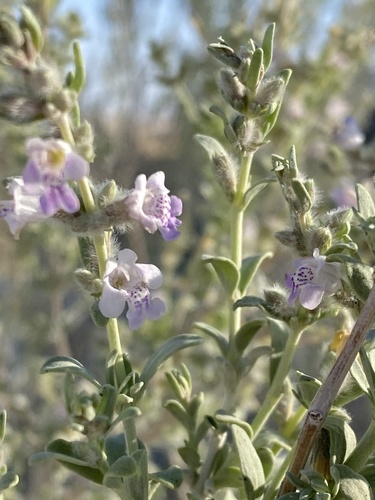
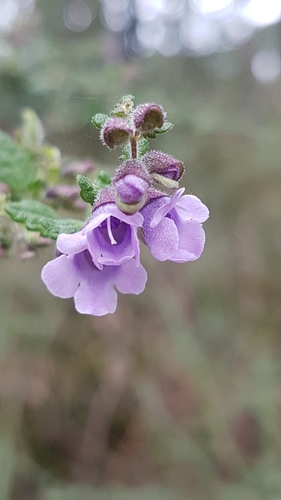
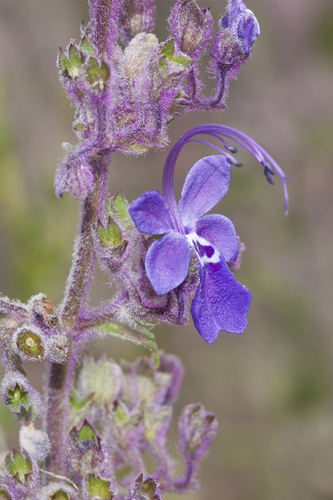
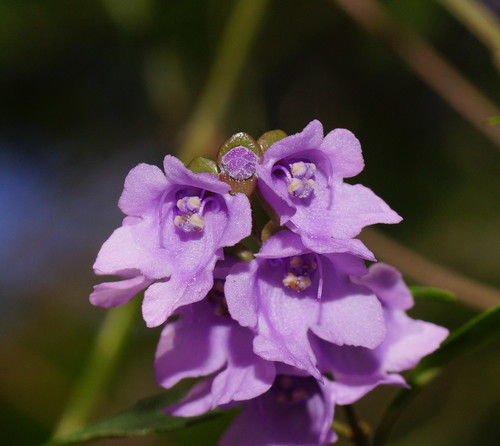
Prostanthera incisa R.Br. is an erect, openly branched shrub that usually grows 0.5 to 3 metres tall and 2 to 3 metres wide. According to George Althofer, this species is described as either 'strongly and rather unpleasantly' aromatic, or as having a 'pleasing aroma emanating from the sensitive leaf glands'. Its branches are ridged, hairy, and densely covered in glands. The leaves are hairy, densely glandular, and shaped from egg-shaped to oblong, with a paler lower surface. Each leaf is 8 to 30 millimetres long, 4 to 12 millimetres wide, and grows on a petiole 1 to 10 millimetres long. Leaf edges are coarsely toothed, and leaf tips are rounded. Flowers grow in clusters near the ends of branches, with bracteoles around 1 millimetre long that drop off as the flower matures. The sepals are 3 to 4.5 millimetres long, forming a tube around 2 millimetres long with two lobes, where the upper lobe is around 2 millimetres long. Petals are pale mauve to mauve and 7 to 10 millimetres long.
Commonly called cut-leaved mint-bush, this species is found along the New South Wales coastline from Mount Warning near the Queensland border all the way to Victoria, and also on the Central Tablelands of New South Wales. It grows in sheltered locations at rainforest margins or in sclerophyll forest under tree species including Sydney blue gum (Eucalyptus saligna), cabbage gum (E. amplifolia), Sydney peppermint (E. piperita), red bloodwood (Corymbia gummifera) and turpentine (Syncarpia glomulifera). It may also grow in scrub along watercourses alongside river she-oak (Casuarina cunninghamiana).
Prostanthera incisa was first grown in England in 1824. P. incisa var. incisa is cultivated on a small commercial scale for essential oil production and as a bushfood spice. In cultivation, P. incisa prefers sheltered positions in well-drained acidic soil, and is susceptible to root rot if grown in poorly drained soil. It tolerates frost down to −5 °C, grows quickly and can be harvested within its first year. If pruned back to 50 centimetres in height, it reshoots easily. It can be propagated from seed or from cuttings taken from firm young growth.