About Prosopis velutina Wooton
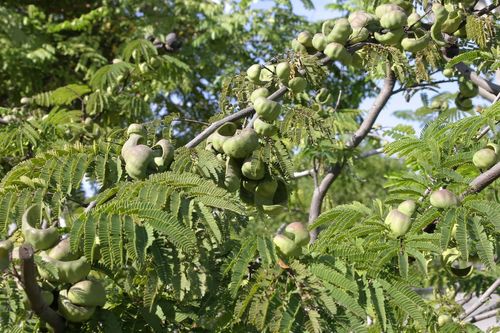
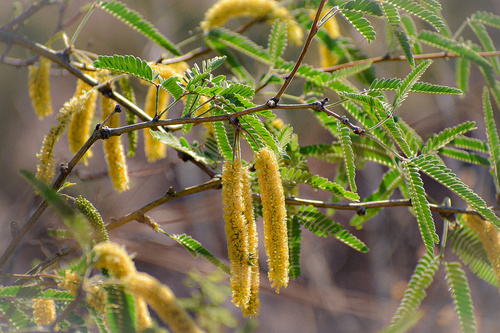
Velvet mesquite (Prosopis velutina Wooton) can reach a height of 30 to 50 feet (9 to 15 meters) or more, growing larger in areas with abundant water and smaller in open, dry grasslands. Its youngest branches are often green and capable of photosynthesis. Young bark is smooth and reddish-brown; as the tree matures, the bark turns dark dusty gray or brown and develops a shredded texture. Yellow thorns up to one inch long grow on the tree's young branches. The leaves are fine, bipinnately compound, and roughly 3 to 6 inches (7.5 to 15 cm) long, and they fold closed at night. This species has an extremely deep taproot, far deeper than the tree is tall, that allows it to access water sources unavailable to most other plants. Roots typically extend to around 50 feet (15 m), but depths of up to 175 feet (53 m) have been recorded. Velvet mesquite is deciduous, dropping its leaves in winter and producing new leaves in spring after all risk of frost has passed. Thanks to its deep root system, it retains its leaves through the dry summer months except during the most severe drought years. Its yellow flowers develop in dense cylindrical catkin clusters roughly 4 inches (10 cm) long in spring, after leaves have emerged. The flowers develop into long legume seedpods, which are bright green and resemble pea pods when young. When mature and dry, the pods are hard and hold several hard, dry, brown seeds. The seeds require scarification to germinate, which most often happens when animals eat the seeds and the seeds pass through the animals' digestive tracts; this process also disperses the seeds widely, as the seeds take several days to pass through an animal's body. Velvet mesquite is native to the Sonoran, Mojave, and Chihuahuan Deserts. It grows at elevations below 4,000 to 5,000 feet (1,200 to 1,500 m) in desert grasslands and near washes, with its main native distribution in central and southern Arizona and adjacent Sonora, Mexico. Near waterways, velvet mesquite can grow into dense deciduous woodlands called bosques. This species plays a large role in the desert ecosystem. Coyotes, round-tailed ground squirrels, collared peccaries, mule deer, white-tailed deer, jackrabbits, and available livestock all eat mesquite pods, and birds feed on its flower buds. As a member of the legume family, mesquite fixes nitrogen in the soil. It can act as a nurse tree for young cacti such as the saguaro, and the shade from its branches provides protection for small mammals, especially burrowing animals. Native Americans used its ground seeds as food, its bark to make baskets and fabrics, its wood for firewood and building, and its leaves and gum for medicine. The range of velvet mesquite has shifted due to grazing: cattle both disperse mesquite seeds and overgraze the land, which reduces the frequency of range fires that would normally control mesquite populations. As a result, mesquite grows more densely and spreads into former grassland, leading to velvet mesquite being classified as an invasive species or noxious weed in several U.S. states. Despite this spread, mesquite bosques today cover only a small fraction of the area they occupied before human settlement. Agriculture, firewood harvesting, housing development, and lowered water tables have all contributed to the loss of native mesquite stands. Velvet mesquite is a common choice for residential and commercial xeriscaping in Tucson and Phoenix, which fall within its natural range. An established mesquite tree needs little to no watering, and makes an attractive ornamental plant. It has documented traditional medicinal uses: hot tea blended from clear sap and inner red bark was used to treat sore throats; tea from fresh leaves treated stomachaches; soft inner root bark was chewed to treat toothache; tea made from dried leaves was consumed before meals to stimulate a poor appetite. A traditional cosmetic use, for men only, was treating hair loss with black sap from mesquite tree wounds mixed with other herbs and applied to the scalp; special mesquite herbal soap for this use is still sold in parts of Mexico. In addition to the traditional use of bark for baskets and fabrics, mesquite wood is valued for firewood and for adding flavor to grilled meat. Mesquite pods are an important food source for humans and native wildlife. They are classified as a slow-release food due to galactomannin gums that have been found to lower glycemic responses, with a glycemic index of 25% compared to 60% for sweet corn and 100% for white sugar. After drying and toasting, the pods are ground into mesquite meal and mesquite flour, which are used to make cakes, breads, muffins, and pancakes.