About Prosopis flexuosa DC.
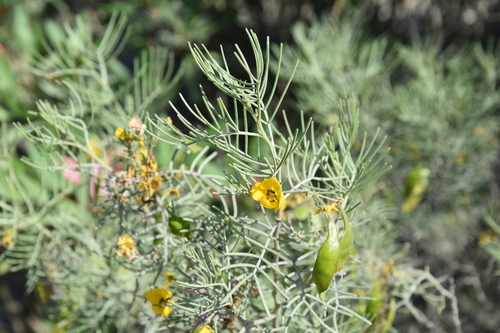
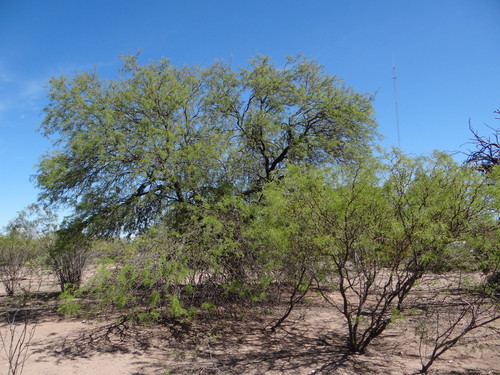
Neltuma flexuosa (synonym: Prosopis flexuosa DC.) includes multiple varieties that grow in distinct forms: either trees (arboreal growth form) or shrubs. The arboreal variety, Neltuma flexuosa var. flexuosa, is a medium-sized deciduous tree that reaches a maximum height of 10 m (33 ft). It has a short trunk and long branches that often grow horizontally, curving upward at their ends. The shrub varieties (var. depressa and var. fruticosa) form multi-stemmed clumps that grow to heights between 2.5 m and 5 m (8 ft 2 in to 16 ft 5 in). This species has petiolate leaves that grow up to 15 cm (6 in) long. The leaf blades are somewhat leathery, and are pinnate, bearing 9 to 17 pairs of leaflets. One (or more commonly a pair of) strong thorns up to 6 cm (2 in) long grows in the axil of each leaf. The flowers are arranged in dense racemes 6 to 14 cm (2 to 6 in) long; each raceme holds approximately 200 individual yellowish flowers. After flowering, the plant produces long yellow pods marked with purplish blotches that have twisted margins and contain a variable number of seeds. The sugar content of the seeds changes based on local soil conditions and growing region, and seeds are usually sweet, though they can sometimes be bitter. There are notable differences in seed shape between northern populations (for example, at Chilecito, Fiambalá and Pipanaco) and southern populations (for example, at San Rafael). Neltuma flexuosa is endemic to arid regions of South America. Its natural range includes western Argentina, northern Chile, and possibly southern Bolivia. It grows at altitudes ranging from sea level to approximately 2,200 m (7,218 ft). It occupies two main habitat types: lowland dry forests and gallery forests. Annual precipitation across its native range falls between roughly 50 mm and 500 mm (2.0 in and 19.7 in). This tree is tolerant of drought, cold, salt, and sand, and is the hardiest species in its genus. It uses water extremely efficiently, produces most of its fruit during drought years, and has been successfully introduced to other arid regions. In its native range, the rainy season typically starts in November, but new leaves emerge in early spring regardless of whether rain has arrived. Leaves may not be shed at all during mild winters. In more humid areas, the dominant tree species is white quebracho (Aspidosperma quebracho-blanco), with N. flexuosa as a secondary dominant alongside chaparral (Larrea divaricata), Mimozyganthus carinatus and Acacia furcatispina. Under more arid conditions, N. flexuosa is often the dominant species in open woodland, growing alongside Chilean greenwood (Geoffroea decorticans), with an understorey that includes caperbush (Capparis atamisquea), saltbush (Atriplex lampa) and seablite (Suaeda divaricata). The flowers produce large amounts of pollen and nectar, and are attractive to bees, which also act as the plant's main pollinators. The dense, hard wood of Neltuma flexuosa is difficult to nail. It is used for livestock fencing, vineyard support poles, joinery, charcoal production, and firewood. The fruits are high in nutrients, and are eaten by local people and used as livestock feed. Beekeepers value this tree for honey production.