About Propithecus verreauxi Grandidier, 1867
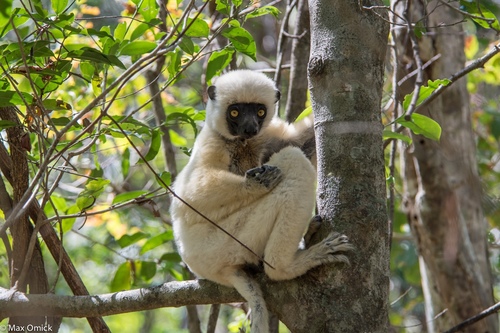
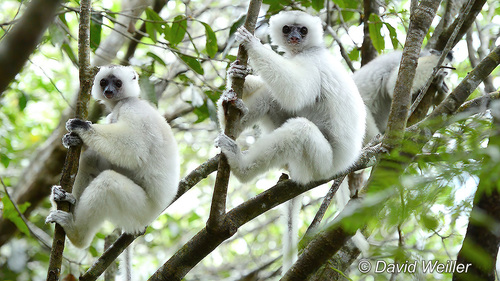
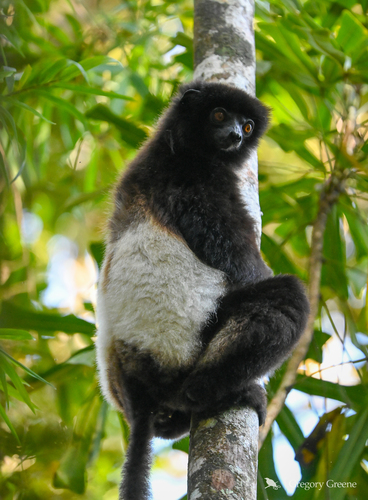
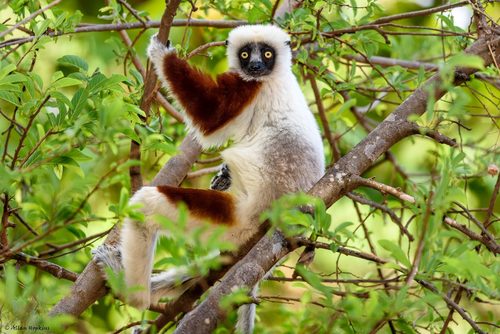
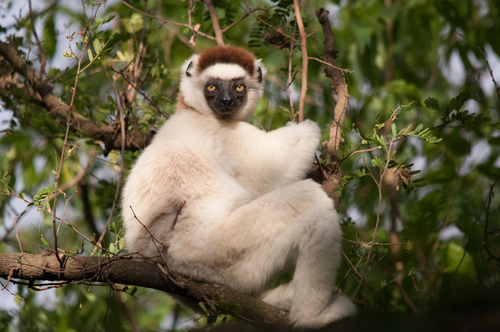
Verreaux's sifaka (Propithecus verreauxi), also called the white sifaka, is a medium-sized primate belonging to the Indriidae, one of the lemur families. Classified as Critically Endangered, this species lives only in Madagascar, and occupies a wide range of habitats: rainforest, dry deciduous forests in western Madagascar, and spiny thickets in southern Madagascar. It has thick, silky fur that is mostly white, with brown coloring on its sides, the top of its head, and its arms; its ventral region is relatively hairless. Its body is adapted for an arboreal lifestyle, with vertical leaping as its main form of locomotion. When moving on the ground, it travels exclusively via a hopping "dancing" gait. Verreaux's sifaka lives in moderately sized groups of approximately 2 to 13 individuals, and is primarily folivorous, meaning it eats mostly leaves.
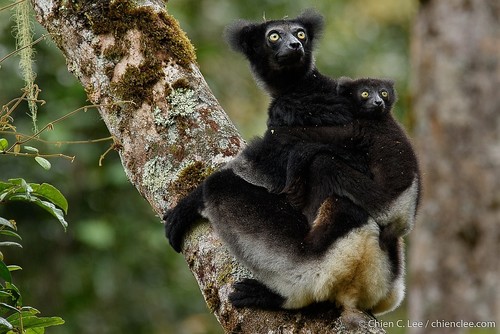
For reproduction, roughly 45% of females breed each year. Females enter oestrus between late January and early February, and give birth to a single infant after a 130-day gestation period, between June and August. For the first 6 to 8 weeks after birth, the infant clings to its mother's stomach; over the following 19 weeks, it travels clinging to the mother's back. Around 30% of infants die from predation by the fossa (Cryptoprocta ferox), and a smaller number are killed by raptors such as the Madagascar harrier-hawk (Polyboroides radiatus). Individuals that survive to maturity reach sexual maturity between 3 and 5 years of age. Males typically leave their natal group to join a neighboring group, while adult females usually remain in their natal group. Dominant males experience an increase in testicle size when other males are present, which improves their chances of successful reproduction.
Verreaux's sifaka is listed in CITES Appendix I, and the IUCN updated its conservation status to Critically Endangered in 2020. In the small fragmented spiny forests of southern Madagascar, the local abundance of this sifaka is affected by two factors: the proportion of large trees, defined as trees with a diameter at breast height of 5 cm or greater, and the abundance of Alluaudia procera, a key plant species for this spiny forest habitat. A long-term, large-scale demographic study of the species at Baza Mahafaly Special Reserve in southwest Madagascar found that the local sifaka population had a population growth rate of 0.98, with confidence intervals crossing 1. This indicates the population was not at imminent risk of extinction. However, severe droughts and increased annual variation in rainfall levels can both lower the species' population growth rate. Even with ongoing habitat loss, P. verreauxi likely still has the largest geographic distribution of all sifaka species.