About Propithecus diadema Bennett, 1832
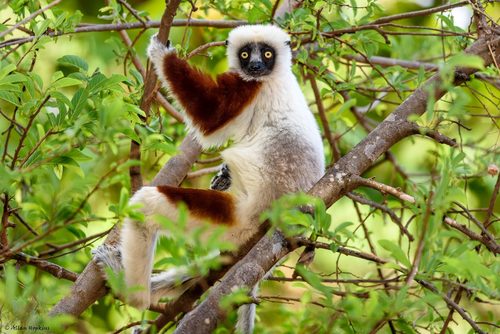
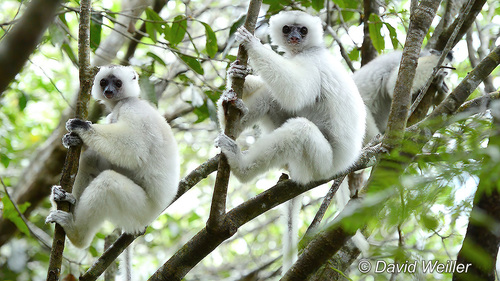
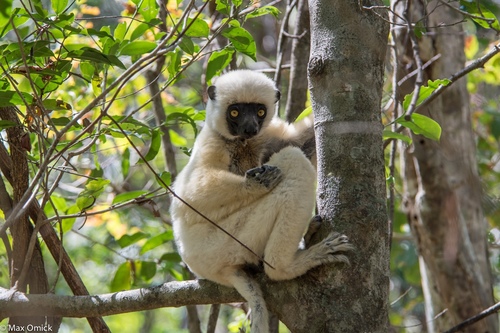
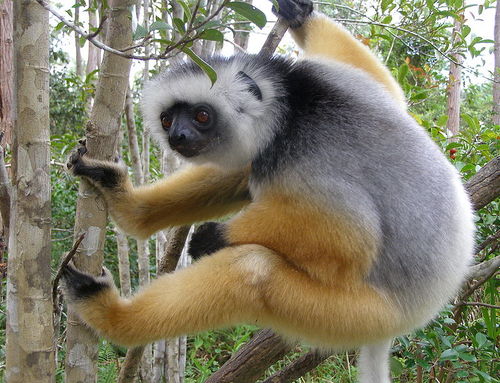
Propithecus diadema, commonly known as the diademed sifaka, can be easily told apart from all other lemur species by its unique markings and large body size. Its full coat is moderately long, silky, and thick and full in texture. Long white fur surrounds its muzzle and covers its cheeks, forehead, and chin, creating the 'diadem' or crown appearance that gives the species its name. The diademed sifaka has reddish brown eyes, a short muzzle, and a bare face that ranges in color from dark gray to solid black. The fur on its crown is also distinctly black, and often extends down to the nape of the neck. Fur on the upper back and shoulders is slate gray, while the lower back is lighter and takes on a silvery tone. The flanks, tail, and ventral (belly) fur are paler gray, and sometimes even white. The species' hands and feet are entirely black, while its arms, legs, and the base of the tail are yellowish-golden. Only males have a large skin gland at the center of the outer throat, which is typically reddish brown. The diademed sifaka is one of the most widely distributed members of the genus Propithecus, though a definitive full map of its range has not yet been completed. The species occurs at elevations between 200 and 800 metres (656 to 2,624 feet) across most of eastern Madagascar's lowland forests, and between 800 and 1,550 metres (2,624 to 5,084 feet) in parts of Madagascar's montane subhumid forests. Both of these ecoregions are part of the Global 200, a collection of the world's most ecologically significant conservation regions. Geographically, its range extends at least as far north as the Mananara River, and as far south as the Onive and Mongoro Rivers. Researchers have recorded clinal variation between Propithecus diadema and Propithecus edwardsi at the extreme southern edge of this range. Like all members of the Indriidae family, this species and its entire genus evolved on the island of Madagascar independent of lemur species on the African mainland. An unusual outlier population of P. diadema has been found in south-central Madagascar; individuals in this population have a range of different colour markings, including at least one recorded observation of an entirely black lemur. DNA analyses have not produced consistent results on whether this group should be classified as a separate new species, so scientists currently classify this outlier group as P. diadema until further research supports a separate species designation. Confirmed locations where diademed sifakas can be seen include Mantadia National Park, which is approximately a three-hour drive from Madagascar's capital city of Antananarivo, and the forests of Tsinjoarivo.