About Propithecus coquereli (Grandidier, 1867)
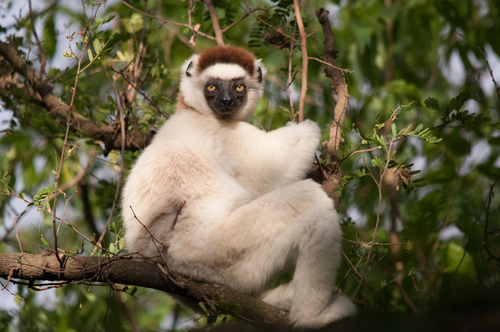
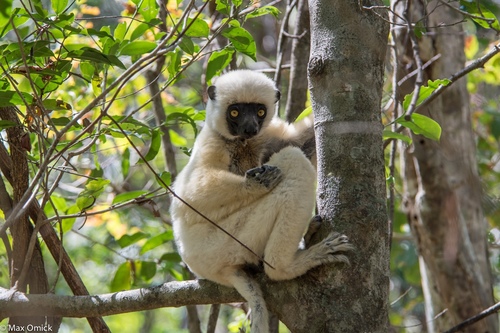
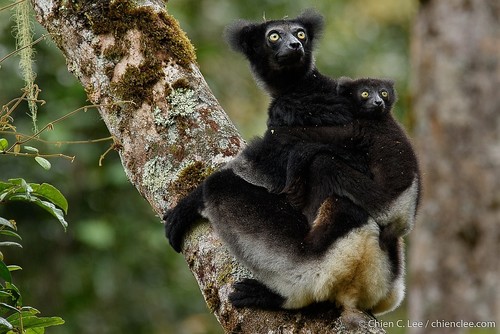
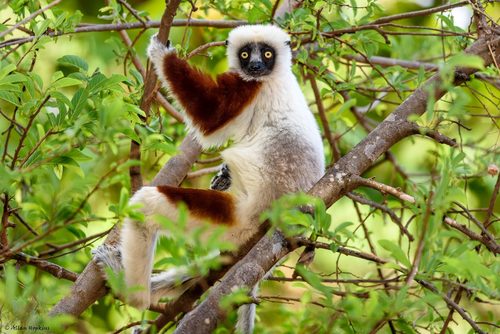
Coquerel's sifaka, scientifically named Propithecus coquereli, has white fur on its back and tail, with maroon patches on the chest and parts of the limbs. Its coat is generally dense. The face is hairless and black, except for a distinct patch of white fur along the bridge of the nose. Its hairless ears are also black, and its eyes are yellow or orange. The undersides of this lemur's hands and feet are black, while its thighs, arms, and chest are chocolate brown. Like all lemurs, Coquerel's sifaka has a toothcomb, which it uses for grooming and sometimes scraping fruit from a pit. This species lives at altitudes below 91 m (300 ft) in the dry deciduous forests of northwestern Madagascar, including coastal forests. Its range extends from the Betsiboka River north to the Maevarano River, across the large area between these two waterways. Extensive distribution surveys carried out in 2009, 2010, and 2011 confirmed that the species is present in most forest fragments between these rivers. However, its eastern distribution boundaries remain unclear. The species has twice been reported absent from the area between the Sofia and Bemarivo Rivers. The southern part of the inter-river region between the Bemarivo and Betsiboka Rivers also lacks clear information on the species' presence, and additional surveys are needed there. Groups of Coquerel's sifaka have home ranges of 4 to 9 hectares (9.9 to 22.2 acres). A 2014 study conducted in Ankarafantsika National Park found that population densities range from 5 to 100 individuals per square kilometer (13 to 259 per square mile). The study also noted significant negative effects of roads and forest edges on population density, and a possible positive effect of proximity to rivers. The total population of the species in Ankarafantsika National Park is estimated to be around 47,000 individuals. Despite this, the species is often observed near villages and in areas dominated by introduced tree species. For reproduction, female Coquerel's sifakas select their own mates. Females have synchronized estrus in January and February. Infants are born in June and July after a gestation period of approximately 162 days. Typically, only one infant is born during Madagascar's dry season, which runs from June to July. Newborn Coquerel's sifakas have an average weight of 100 g (3.5 oz), with weights ranging between 85 and 115 g (3.0 and 4.1 oz). A newborn clings to its mother's chest until around one month after birth, then moves to ride on her back. Infants are weaned and become fully independent around six months of age. They reach adult size between one and five years old. Both males and females become sexually mature between two and three and a half years old, though some individuals do not produce their first offspring until they are six years old. Hybrids between Coquerel's sifaka and other Propithecus species are known to occur, including hybrids with P. verreauxi.