About Propithecus candidus Grandidier, 1871
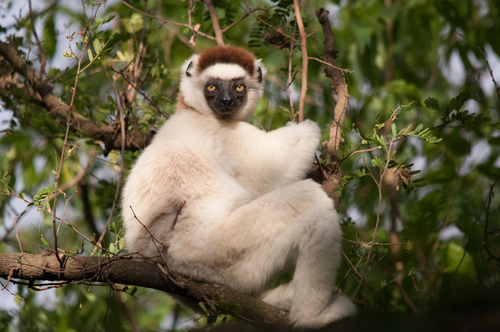
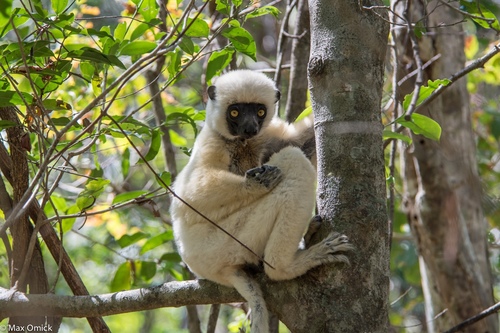
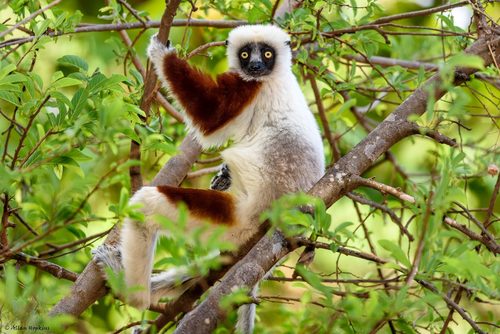
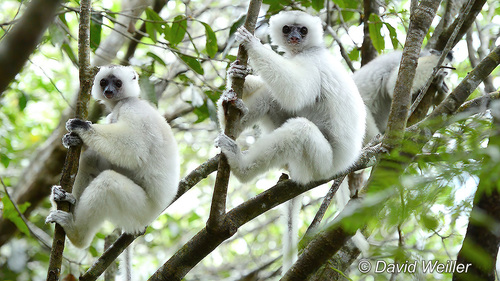
Scientific name: Propithecus candidus Grandidier, 1871. The silky sifaka is one of the largest sifaka species. It has a head-body length of 48–54 cm (1.6–1.8 ft), a tail length of 45–51 cm (1.5–1.7 ft), a total length of 93–105 cm (3.1–3.4 ft), and a weight of 5–6.5 kg (11–14 lb). As its common English name suggests, its long, white fur has a silky texture. Not all individuals are completely white: some have silver-gray or black tints on the crown, back, and limbs. The base of the tail, called the pygal region, can be yellow. The ears and face are hairless, and the skin may be a mix of pink and black, completely black, or completely pink. The tips of the ears protrude slightly above the fur on the rest of the head. Its eyes have a deep orange-red coloration. Its appearance is distinctive, and since no other sifakas share its range, it is not easily confused with other lemur species. While it is difficult to tell adult males and females apart in other eastern rainforest sifakas, such as Perrier's sifaka and Milne-Edwards' sifaka, gender in the silky sifaka is easily identified due to differences in fur coloration on the upper chest. Females have white fur, while males have a large brown fur patch that forms from scent marking with a gland on the chest and throat, the sternal gular gland. During mating season, the size of the male's chest patch increases to cover both the chest and abdomen as a result of increased scent marking. The silky sifaka lives only in a small region of northeastern Madagascar, within a strip of humid forest that stretches from Maroantsetra in the south to the Andapa Basin and the Marojejy Massif in the north. Marojejy National Park marks the northern limit of its current distribution, although historical sifaka range maps created by Grandidier and Milne-Edwards in the late 19th century show the silky sifaka ranging as far north as the Bemarivo River, north of Sambava. The Androranga River may be the northwestern range limit within the Tsaratanana Corridor. The southern limit of its range appears to be the Antainambalana River, within the Makira Conservation Site. It is not known if the silky sifaka has ever ranged as far south as the Masoala Peninsula. As of 2009, new observations of a few groups of the silky sifaka in unprotected forest fragments adjacent to northeastern Makira (Antohaka Lava and Maherivaratra) may slightly expand the species' known geographic range. The presence of the silky sifaka has been documented within Marojejy National Park, Anjanaharibe-Sud Special Reserve, the Makira Forest Protected Area, the Betaolana Corridor, and the Tsaratanana Corridor. In 2008, 16 groups were discovered in western Marojejy near Antsahaberoaka. The silky sifaka tends to be found at higher elevations than any other sifaka species, and also occupies the widest elevation range of all sifaka species. In Marojejy National Park and Anjanaharibe-Sud Special Reserve, where most of the remaining groups live, it is not found below 700 m (2,300 ft) of elevation and not above 1,875 m (6,152 ft). However, at its southernmost location in Makira (Andaparaty), several groups live in forest fragments at an unusually low elevation of 300 m (980 ft). The silky sifaka lives in three types of elevation-specific habitats: primary montane rainforest, sclerophyllous forest, and the highest portions of low ericoid bush. It remains unknown how sensitive the silky sifaka is to disturbance, or whether it is edge-intolerant and avoids habitat edges, or more edge-tolerant like diademed sifakas. Like other rainforest sifaka species, it seldom crosses unforested areas between forest fragments. In the Anjanaharibe-Sud Special Reserve, the silky sifaka shares its range with the white-fronted brown lemur (Eulemur albifrons) and an all-black population of indri (Indri indri). In Marojejy National Park, it is sympatric with the white-fronted brown lemur. In 2008, researchers suggested the silky sifaka is sympatric with the red ruffed lemur (Varecia rubra) near Maherivaratra and Andaparaty.