About Promerops gurneyi J.Verreaux, 1871
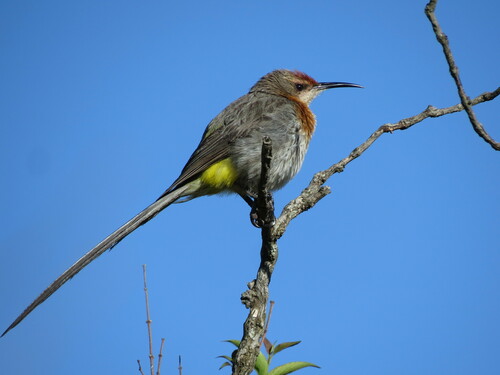
Gurney's sugarbird (Promerops gurneyi J.Verreaux, 1871) has a long, decurved bill that is characteristic of nectar-feeding bird species. It has a chestnut-coloured forehead, a faint white eyestripe, and a white mustachial stripe. A white throat contrasts sharply with its russet breast, while its back is dark grey, and its conspicuous bright yellow rump makes the species easy to identify. The tail is long and graduated, ranging from 11 to 19.3 cm in length. The total body length of the species ranges between 23 and 29 cm. Males have a body mass of 30 to 46.5 g, while females range from 23 to 43 g. Females are smaller than males, with shorter bills and tail feathers. Males also have a triangular bulge on the sixth primary feather, which is used during mating displays. Immature individuals are duller in colour than adults, and have a greenish tinge on both their breast and yellow rump. Their secondary feathers are also edged with brown. The two recognized subspecies of Gurney's sugarbird have minor differences in appearance. Individuals of the nominate subspecies P. g. gurneyi match the general description above. In contrast, P. g. ardens individuals tend to be darker overall, with a greener rump and a richer chestnut breast than the nominate subspecies. Gurney's sugarbird moults its primary and secondary flight feathers during the breeding season, while tail feathers are moulted continuously throughout the year. This continuous tail moult occurs because the long tail feathers, which play an important role in mating displays, are easily damaged and need to be replaced quickly. Gurney's sugarbird is a species endemic to Southern Africa, with a fragmented distribution. It is mainly found in elevated regions of north-eastern Mountain Sourveld and north-eastern Sandy Highveld in the Transvaal and Natal regions, and also occurs in the Highland and Dohne Sourvelds of Natal, extending into the Eastern Cape and Limpopo provinces. An isolated population of the P. g. ardens subspecies lives in the highlands of Eastern Zimbabwe and adjacent Mozambique. Gurney's sugarbird is a short-distance altitudinal migrant, and leaves its breeding grounds once the flowering season ends. Its preferred habitat is the shrubland velds of Southern Africa, which are dominated by sugarbush (Protea) flowering plants. The distribution of Gurney's sugarbird overlaps with the ranges of silver sugarbush (Protea roupelliae), white protea (P. subvestita), and common sugarbush (P. afra). Because Gurney's sugarbird is only associated with Protea shrubs, it is very vulnerable to habitat loss and displacement caused by fires. Its distribution is limited by its highly specialized diet, which centers on nectar from sugarbush species. The birds also feed on nectar from Aloe plants in suburban gardens. The P. g. ardens subspecies evolved in an area that lacks silver sugarbush, so it instead relies on miombo trees (genus Brachystegia), African protea (P. gageudi), Nyanaga protea (P. dracomontana), beard protea (P. crinitita), and common sugarbush (P. afra) as food resources. P. g. ardens inhabits riparian woods and dry slopes with abundant flowering shrubs including Protea, bird of paradise flowers (Strelitzia), and coral trees (Erythrina). Gurney's sugarbird is a socially monogamous species, meaning pairs stay together through the breeding season. The breeding season runs from September, when pairing and nest-building occur, to late February, when fledglings leave their parents' territory. Females choose mates based on male morphological features and display flights, which involve flicking the long tail and producing a wing-clack sound using the triangular bulge on the male's sixth primary feather. Longer tails and larger feather bulges for wing-clacking are linked to higher mating success in males. Males also perform display flights when chasing away encroaching individuals, most often other males, from their territory. Reproductive success in Gurney's sugarbird depends heavily on available resources like abundant nectar and insects. Typically, males defend these resources, while females handle nest building, egg incubation, and feeding nestlings. The species has a small clutch size, usually 1 to 2 eggs, which is associated with its relatively long lifespan of up to seven years, with a maximum recorded longevity of 13 years. Individuals usually reach sexual maturity in their second or third year of life, and therefore experience an average of five breeding seasons over their lifetime. Incubation lasts 16 to 17 days, and brooding (keeping chicks warm after hatching) lasts between 19 and 23 days. Both parents help feed nestlings, usually bringing back small winged insects and beetles. Chicks depend on their parents for food for the first month of life.


