About Promerops cafer (Linnaeus, 1758)
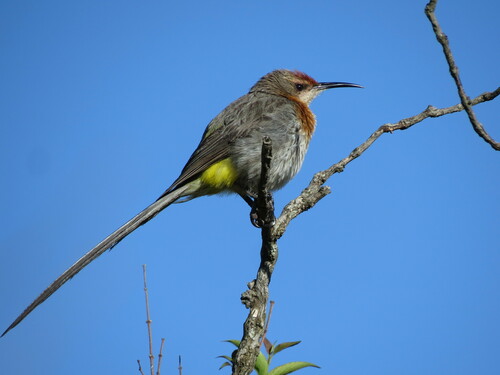
Promerops cafer, commonly called the Cape sugarbird, has a grey-brown body. Individuals are easily identifiable by a yellow spot under the tail, and males have very long tail feathers. Males measure 34 to 44 cm in total length. Females are smaller overall at 25 to 29 cm long, with shorter tails, shorter bills, and paler breasts than males. A distinct characteristic of this species is the sound it produces during flight. The arrangement of its main flight feathers means that wing beats create a frrt-frrt sound, which the bird uses to attract females. The Cape sugarbird is found across most of the fire-driven Fynbos ecosystem in South Africa. This ecosystem is the dominant vegetation type of the Cape Floral Region, and the species occurs where flowering proteas and ericas grow. It is most abundant in areas that have not burned recently, and is nearly absent from areas that have burned recently. When most proteas are not in flower during the summer, the Cape sugarbird can also be found in residential gardens; however, birds living in urban areas show higher measures of stress. The species has an extensive range and a large total population, so it is currently rated as Least Concern on the IUCN Red List of Threatened Species. The Cape sugarbird is a specialist nectar feeder that feeds on plants from the Proteaceae family. Its long, sharp beak reaches into protea flowers to access nectar, and it uses a long, brush-tipped tongue to collect the nectar. Nectar forms the staple diet of this species, but it will also eat spiders and other insects. Strong winds are common in the Cape region, which can make feeding on protea flower heads challenging. The Cape sugarbird has adapted to this condition by developing sharp claws.