About Progne tapera (Linnaeus, 1766)
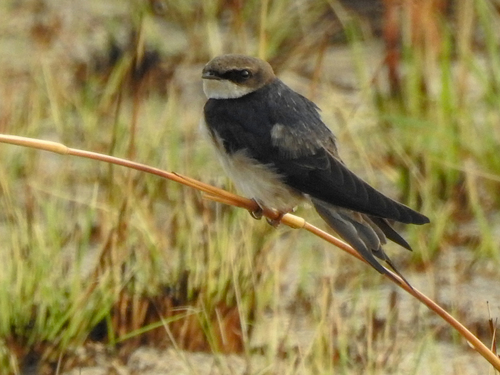
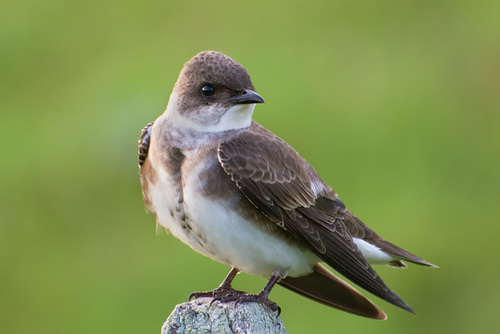
The brown-chested martin, Progne tapera (Linnaeus, 1766), measures 16 to 18 cm (6.3 to 7.1 in) in length and weighs 30 to 40 g (1.1 to 1.4 oz). Males and females share identical plumage. Adults of the nominate subspecies have a mostly sandy brown head with a white chin and throat, and their upperparts are also sandy brown. Their tail is slightly forked; both the tail and wings are a darker brown than the upperparts. Their underparts are mostly white, with an indistinct brown band across the breast. The subspecies P. t. fusca is larger and overall darker than the nominate subspecies, with a more clearly defined breast band and dusky markings on the lower breast and belly. Juveniles have a more squared tail than adults, and a grey-brown wash on the sides of the throat.
The nominate subspecies of the brown-chested martin occurs in two separate areas: one spanning from northern and eastern Colombia east through Venezuela, the Guianas, and far northern and northeastern Brazil, and another on the west side of the Andes from Los Ríos Province in southwestern Ecuador south into northwestern Peru's Tumbes Department. The range of subspecies P. t. fusca overlaps the nominate's range; this subspecies is found in Panama and across all of South America east of the Andes, extending as far south as La Pampa and Buenos Aires provinces in Argentina. The brown-chested martin lives in semi-open to open landscapes including grasslands, cultivated areas, forest clearings, and human settlements, and it prefers areas located near water. In Venezuela, the nominate subspecies occurs below 1,000 m (3,300 ft). Subspecies P. t. fusca is found mostly below 400 m (1,300 ft) in Venezuela, though there are confirmed sightings up to 1,900 m (6,200 ft). Across the species' full range, it reaches elevations of 2,500 m (8,200 ft) in Colombia, and 600 m (2,000 ft) in Ecuador and Peru.