About Progne subis (Linnaeus, 1758)
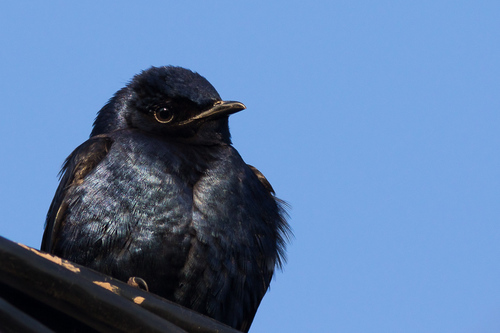
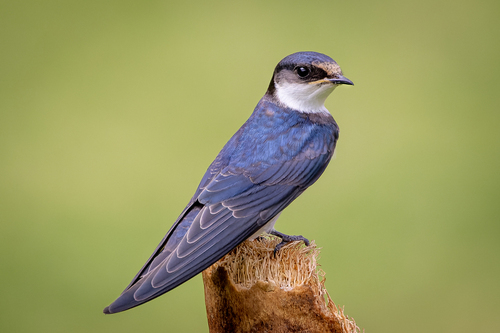
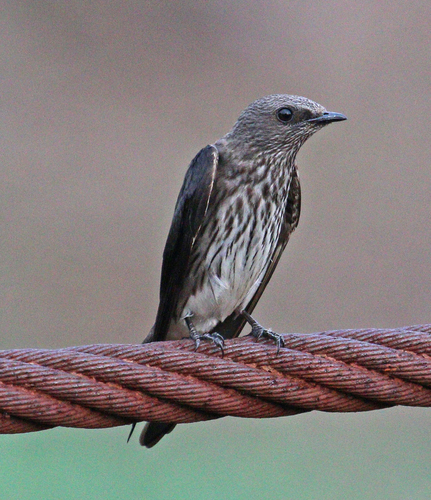
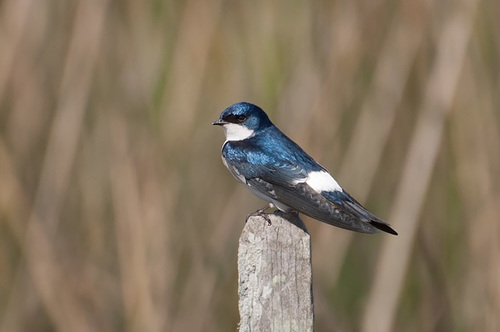
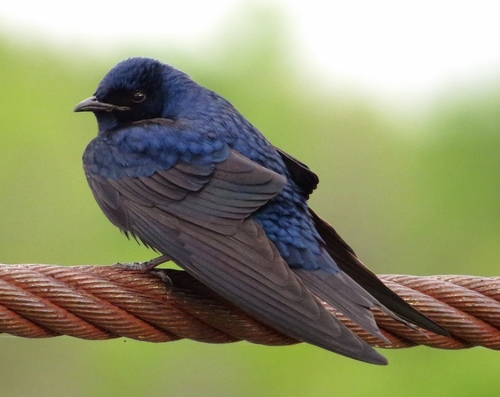
The purple martin, Progne subis (Linnaeus, 1758), is the largest species in the swallow family Hirundinidae, which contains around 90 species. It averages 20 cm (7.9 in) in length, with a wingspan reaching up to 38 cm (15 in). Full measurement ranges for the species are: length 19–20 cm (7.5–7.9 in), weight 45–60 g (1.6–2.1 oz), and wingspan 39–41 cm (15.3–16.1 in). Purple martins are sexually dimorphic. Adult males are entirely black with a glossy steel blue sheen, and they are the only swallow in North America with this coloration. Adult females are dark on the upper body with some steel blue sheen, and have lighter underparts. All adult purple martins have a slightly forked tail. Both sexes exhibit delayed plumage maturation, meaning full adult plumage is not acquired until the bird is two years old. Subadult females resemble adult females, but lack the steel blue sheen and are browner on the back. Subadult males look very similar to females, but develop solid black feathers in a blotchy, random pattern across their chest as they molt into adult plumage. Purple martins are quite vocal, producing a range of sounds including chirps, chortles, rattles, and croaks. Their various calls are described as "throaty and rich", and have been transcribed as tchew-wew, pew pew, choo, cher, zweet, and zwrack. Males produce a gurgling, guttural courtship song, a distinct dawn song, and a subsong used at the end of the breeding season. Recordings of purple martin song are sold to attract these birds to newly built birdhouses. Species in the Progne genus are very closely related, and some researchers classify the purple martin, gray-breasted martin, Caribbean martin, and southern martin as a single superspecies. Purple martins have a breeding range that spans temperate North America. Their breeding habitat consists of open areas across eastern North America, plus scattered locations along the west coast from British Columbia to Mexico. Purple martins build nests inside cavities, which may be natural or human-made. In many regions, especially eastern North America, people install hollow natural or artificial gourds or purpose-built birdhouses for purple martins, and in this region purple martins are almost entirely dependent on these human-provided nest structures. As a result, the eastern subspecies typically breeds in colonies located near human settlements, even within cities and towns. This dependence makes the purple martin's distribution patchy, as they are usually absent from areas where no nest sites are provided. Western populations of purple martins often use natural cavities, such as old woodpecker holes in trees or saguaro cacti. Purple martins migrate to the Amazon basin to spend the winter. Their winter range extends into Ecuador, but they do not appear to travel far up the Andean foothills. There are multiple confirmed records of long-distance vagrancy for this species. The first recorded sighting in Europe was in Dún Laoghaire, Leinster, Ireland, in 1839 or 1840. The species was recorded at least six other times in the British Isles during the 1800s, with more recent confirmed sightings from Scotland in 2004, and the Azores in 2004 and 2011. There is also a record of two individuals seen at Stanley, Falkland Islands (Las Malvinas) in 2004, and multiple records from Alaska, including sightings on Saint Paul Island in the Bering Sea and in Fairbanks. Purple martins are insectivores that hunt primarily by hawking: catching insects mid-flight. They are agile hunters and eat a wide variety of winged insects. They rarely come to the ground to feed on insects. They typically fly at relatively high altitudes, so contrary to common belief, mosquitoes do not make up a large part of their diet. However, 2015 research indicates that purple martins do feed on invasive red imported fire ants (Solenopsis invicta), and these ants may make up a significant portion of their diet.