About Progne elegans S.F.Baird, 1865
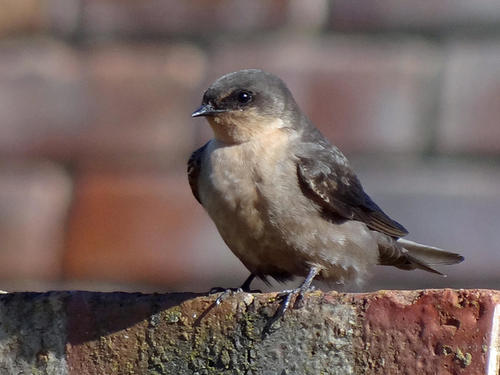
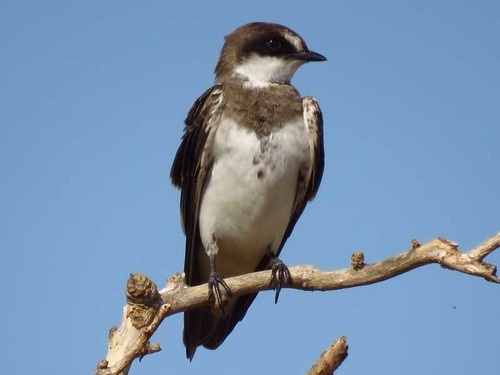
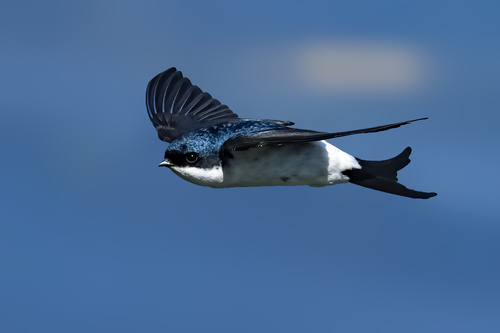
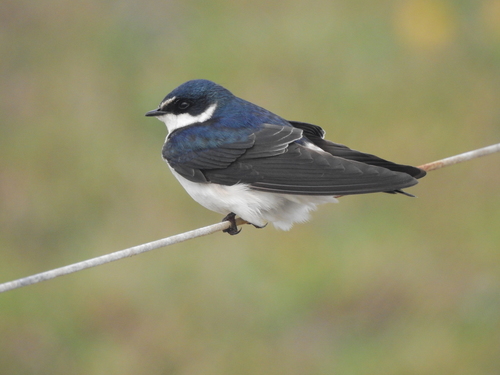
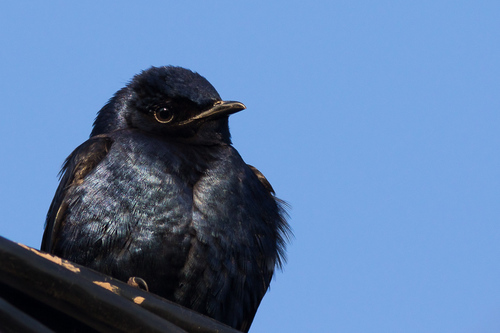
This species is commonly known as the southern martin, with the scientific name Progne elegans S.F.Baird, 1865. Adult southern martins measure 17 to 20 cm (6.7 to 7.9 in) in length. The species exhibits sexual dimorphism, though both sexes share a deeply forked tail. Adult males are almost entirely glossy steel-blue, with darker black wings and tail. Females have duller steel-blue upperparts than males; their underparts are mostly dusky brown, with paler feather edges that create a scaly appearance, and their undertail coverts are white with dusky streaks. Juvenile southern martins look similar to adult females. Multiple sources do not agree on the southern martin's geographic range. The South American Classification Committee reports that the species breeds in Argentina, Bolivia, and Chile, and occurs as a non-breeding visitor in Brazil, Ecuador, French Guiana, Paraguay, Peru, Suriname, and Uruguay. This committee has unconfirmed sight records from Colombia, Guyana, and Venezuela, and confirmed records of vagrancy to the Malvinas/Falkland Islands. BirdLife International (BLI) adds Paraguay and Uruguay to the species' breeding range, lists it as non-breeding in Brazil, Colombia, Panama, and Peru, and does not include any other countries in its recognized range. The Cornell Lab of Ornithology's Birds of the World states that the southern martin breeds in southern Bolivia and Argentina, and spends the austral winter in Brazil, Colombia, and Peru, but possibly also as far north as eastern Panama. This source further notes that some individuals may overwinter in Argentina, the species has been recorded in Uruguay, and it is accidental in the Malvinas/Falklands and Florida. The American Ornithological Society states that the species breeds in Argentina, Bolivia, Paraguay, and Uruguay and winters in Brazil, Colombia, and Peru. It notes that sight records in Panama may pertain to this species, and documents vagrancy to the Falklands and Florida. The southern martin lives in a variety of semi-open to open landscapes, including grasslands, woodlands, scrublands, and areas of human habitation. Just like its overall range, the species' upper elevation limit is reported differently across sources. Cited upper limits are 500 m (1,600 ft), 2,600 m (8,500 ft), and 4,270 m (14,000 ft); it is reported to reach up to 2,500 m (8,200 ft) in Brazil.