About Profenusa thomsoni (Konow, 1886)
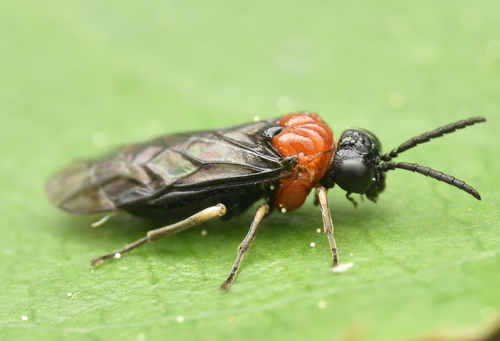
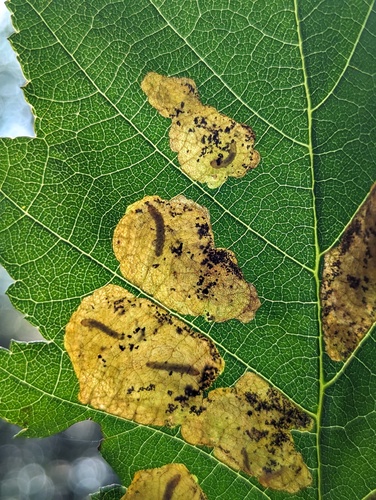
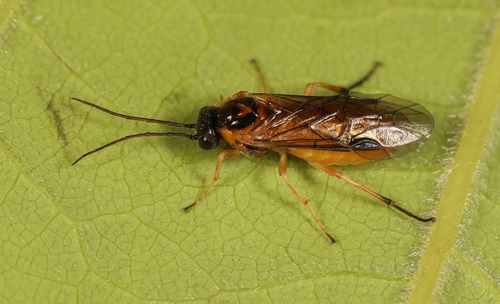
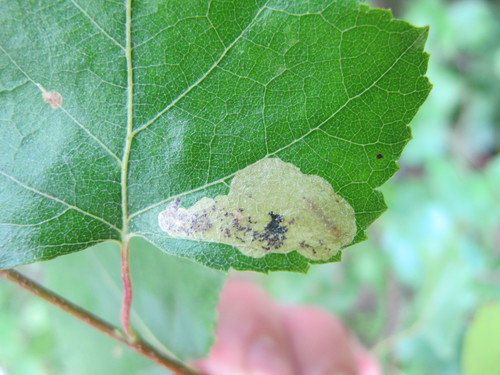
Adults of Profenusa thomsoni are solid black, about 3 mm (0.12 in) long, and have a fly-like appearance. Whitish larvae have short legs, dark markings on the first thoracic segment, and two black spots on each of the second and third thoracic segments. This species develops inside leaf blades: eggs are usually laid close to the leaf midrib, and larvae hollow out a distinctive blotch-shaped cavity inside the leaf. There are six larval instars total, with the final instar occurring on the ground as the larva searches for a pupation site. This species is very similar to the related birch leaf-mining sawfly Fenusa pumila, but the two species differ in their host leaf preferences and leaf damage. F. pumila typically infests young, expanding leaves and causes the leaf blade to crinkle, while P. thomsoni infests mature leaves that remain undistorted after mining. Profenusa thomsoni is widely distributed across the Palearctic realm of Europe and Asia. It was introduced to North America in the early twentieth century, where it became an invasive species. It had spread to Alberta by 1970, and reached Alaska by 1996. Larvae feed on multiple birch (Betula) species and other plants in the family Betulaceae. All individuals of P. thomsoni are female, and reproduction occurs through parthenogenesis. Eggs are laid inside mature host tree leaves, usually near the midrib. Larvae feed on leaf mesophyll tissue inside the leaf, forming a pale brown, blotch-shaped mine. A single leaf may host multiple developing larvae. When larvae are fully mature, they exit the leaf through its underside and fall to the ground, where they create chambers for pupation. They overwinter inside these pupation chambers, and emerge as adult sawflies the following year in July and August. There is only one generation of P. thomsoni per year. P. thomsoni and F. pumila often occur on the same host tree, and heavy infestations can cause extensive defoliation. The species is uncommon in its native European range, but populations grew rapidly after its introduction to North America. In Alberta, P. thomsoni populations dropped sharply in the early 1990s and have stayed low ever since. This population decline is linked to attack by the parasitic wasp Lathrolestes luteolator; before this decline, the wasp had parasitized other sawfly larval species, and this host-parasite relationship with P. thomsoni was the first recorded observation of the interaction. Parasitic wasps lay their eggs in late-stage P. thomsoni leaf miner larvae, and wasp larvae mostly develop inside the miner’s overwintering prepupae.