About Profelis aurata (Temminck, 1827)
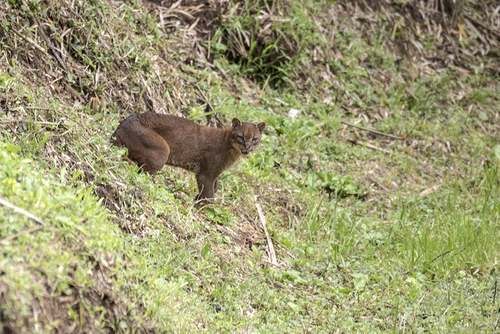
The African golden cat, scientifically named Profelis aurata (Temminck, 1827), has a wide range of fur colors, from chestnut or reddish-brown, greyish brown to dark slate. Some individuals have spots that range in color from faded tan to black. In other individuals, spotting is only present on the belly and inner legs. The cat’s undersides, as well as the areas around its eyes, cheeks, chin, and throat, are lighter in color, ranging to almost white. Its tail is darker on the top, and may be heavily banded, lightly banded, or plain, ending in a black tip. Individuals in the western parts of the African golden cat’s range generally have heavier spotting than those in the eastern region. Scientists once thought that two color morphs, a red phase and a grey phase, indicated separate species, rather than color variations of the same species. In grey individuals, the middle zone of each hair is not pigmented, while the hair of red individuals is intensely pigmented red. Melanistic individuals have entirely black hair. African golden cat skins can be identified by a distinctive whorled ridge of fur in front of the shoulders, where the hairs change direction. The African golden cat is about twice the size of a domestic cat, with a rounded head that is very small relative to its body size. It is a heavily built wild cat, with stocky, long legs, a relatively short tail, and large paws. Its body length typically ranges from 61 to 101 cm (24 to 40 in), its tail length ranges from 16 to 46 cm (6.3 to 18.1 in), and its shoulder height is around 38 to 55 cm (15 to 22 in). It weighs between 5.5 to 16 kg (12 to 35 lb), and males are larger than females. Overall, the African golden cat resembles the caracal, but differs from it in having shorter untufted ears, a longer tail, and a shorter, more rounded face. It has small, rounded ears, and its eye color ranges from pale blue to brown. The African golden cat is distributed across Africa from Senegal to the Central African Republic and Kenya, extending as far south as northern Angola. It inhabits tropical forests from sea level up to an elevation of 3,000 m (9,800 ft). It prefers dense, moist forest with heavy undergrowth located close to rivers, but it also lives in cloud forest, bamboo forests, and high moorland habitats. It has been recorded in Guinea’s National Park of Upper Niger in surveys from 1996 to 1997; in Uganda’s Kibale National Park, an individual was recorded in an Uvariopsis forest patch in 2008; it was recorded in forested areas of Gabon’s Moukalaba-Doudou National Park during surveys in 2012; and it was first recorded in Tanzania’s Minziro Forest Reserve in 2018. Because of the African golden cat’s extremely reclusive habits, very little is known about its behaviour. It is solitary, and normally crepuscular or nocturnal, though it has also been observed hunting during the day, depending on the availability of local prey. African golden cats can climb, but hunt primarily on the ground. They mainly feed on tree hyrax and rodents, and also hunt birds, small monkeys, duikers, young giant forest hog, and small antelope. They have also been recorded taking domestic poultry and livestock. All current knowledge of the African golden cat’s reproductive habits comes from study of captive individuals. Females give birth to one or two kittens after a gestation period of around 75 days. Newborn kittens weigh 180 to 235 g (6.3 to 8.3 oz). Their eyes open within a week of birth, and they are weaned at 6–8 weeks. They grow and develop more rapidly than other small cat species. One individual was recorded scaling a 40-cm wall just 16 days after birth, demonstrating a high degree of physical agility from an early age. Females reach sexual maturity at 11 months of age, while males reach sexual maturity at around 18 months. Captive African golden cats live up to 12 years; their lifespan in the wild remains unknown.