About Procyon lotor (Linnaeus, 1758)
Scientific name: Procyon lotor (Linnaeus, 1758)
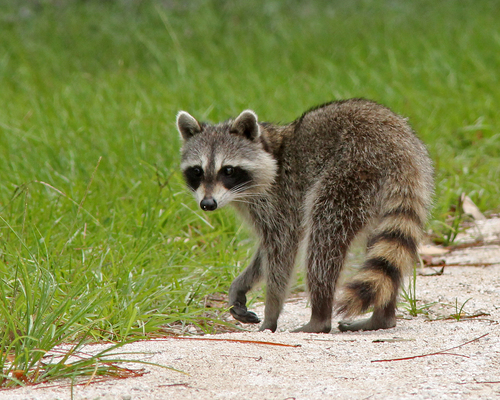
Physical characteristics: Raccoons measure 40 to 70 cm (16 to 28 in) from head to hindquarters, not including their bushy tail, which ranges from 20 to 40 cm (7.9 to 15.7 in) and is most often no longer than 25 cm (9.8 in). Their shoulder height falls between 23 and 30 cm (9.1 to 11.8 in). Adult raccoon body weight varies dramatically based on habitat, making them one of the most variably sized mammals. Weight can range from 2 to 26 kg (4.4 to 57.3 lb), but most adults weigh between 5 and 12 kg (11 and 26 lb). The smallest individuals are found in southern Florida, while the largest tend to live near the northern edge of the species’ range, following Bergmann’s rule. Males are typically 15 to 20% heavier than females. Before winter, fat storage can make a raccoon twice as heavy as it was in spring. The largest recorded wild raccoon weighed 28.4 kg (63 lb) and measured 140 cm (55 in) in total length, making it by far the largest procyonid ever recorded.
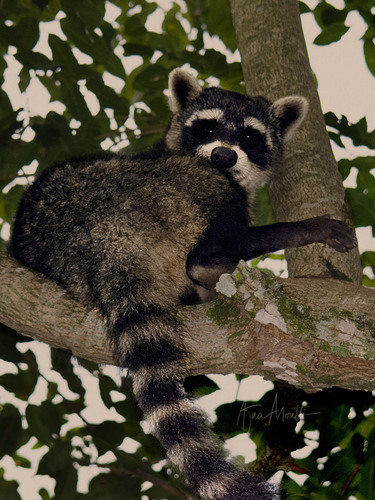
The raccoon’s most distinctive physical trait is the patch of black fur surrounding its eyes, which contrasts sharply with the white fur on the rest of its face. This pattern resembles a bandit’s mask, which has contributed to the animal’s reputation for mischief. Slightly rounded ears are also edged with white fur. The prominent facial coloration and alternating light and dark rings on the tail are thought to help raccoons quickly recognize facial expressions and postures of other members of their species. The dark eye mask may also reduce glare to improve night vision.
On the rest of the body, long, stiff moisture-shedding guard hairs are most often gray, with brown as a secondary color. Very dark-coated raccoons are more common in German populations, because dark-colored individuals were among the first released into the wild there. The dense underfur makes up almost 90% of the raccoon’s coat, provides insulation against cold weather, and consists of hairs 2 to 3 cm (0.79 to 1.18 in) long.
Raccoons are typically plantigrade walkers, and can stand on their hind legs to examine objects with their front paws. Because their legs are short relative to their compact torso, raccoons cannot usually run quickly or jump long distances. Their maximum short-distance speed is 16 to 24 km/h (9.9 to 14.9 mph). They can swim at an average speed of approximately 5 km/h (3.1 mph) and stay in water for several hours. To climb down a tree headfirst—an unusual ability for a mammal of its size—a raccoon rotates its hind feet to point backwards. Raccoons have a dual temperature regulation cooling system: they can both sweat and pant to dissipate heat.
Raccoon skulls have a short, wide facial region and a large braincase. Facial length is shorter than cranial length, and nasal bones are short and quite broad. The auditory bullae are inflated, and the sagittal crest is weakly developed. Raccoons have 40 teeth, with the dental formula 3.1.4.2 / 3.1.4.2, adapted to their omnivorous diet: their carnassials are not as sharp and pointed as those of fully carnivorous mammals, but their molars are not as wide as those of herbivores. The male raccoon’s penis bone is about 10 cm (3.9 in) long and strongly bent at the front end, and its shape can be used to tell juvenile and mature males apart. Of the 13 identified raccoon vocal calls, seven are used for communication between mother raccoons and their kits, including a bird-like twittering made by newborns.
Habitat: While raccoons have adapted successfully to sparsely wooded areas in recent decades, they rely on vertical structures to climb when they feel threatened. For this reason, they avoid open terrain and areas with dense concentrations of beech trees, as beech bark is too smooth to climb. Raccoons prefer tree hollows in old oaks or other trees, and rock crevices, as sleeping dens, winter dens, and birthing dens. If these preferred dens are unavailable or difficult to reach, raccoons will use burrows dug by other mammals, dense undergrowth, or tree crotches. A study conducted in Germany’s Solling hills found that over 60% of all raccoon sleeping sites are used only once, but sites used at least ten times account for around 70% of all total den uses.
Since amphibians, crustaceans, and other shore animals of lakes and rivers are an important part of the raccoon’s diet, lowland deciduous or mixed forests with abundant water and marshes support the highest raccoon population densities. Population densities range from 0.5 to 3.2 raccoons per square kilometer (1.3 to 8.3 per square mile) in prairies, and usually do not exceed 6 raccoons per square kilometer (15.5 per square mile) in upland hardwood forests, but lowland forests and marshes can hold more than 20 raccoons per square kilometer (51.8 per square mile).
Distribution in North America: Raccoons are widespread across North America from southern Canada down to Panama, where the subspecies Procyon lotor pumilus lives alongside the crab-eating raccoon (Procyon cancrivorus). The Hispaniola raccoon population was wiped out by Spanish colonists who hunted them for meat; historian Oviedo recorded they were extirpated in 1513. Raccoons were also extirpated in Cuba and Jamaica, with the last confirmed Jamaican sighting reported in 1687. The Barbados raccoon went extinct relatively recently, with the last sighting in 1964. When raccoon populations on the Bahamas, Guadeloupe, and the Tres Marias Islands were still considered separate species, the IUCN classified them as endangered in 1996.
In Colonial America, raccoons were uncommon outside the Eastern United States, the Gulf Coast, and the Great Lakes region. Since raccoons were not mentioned in early accounts by pioneers exploring central and north-central parts of the United States, their initial range expansion likely began a few decades before the 20th century. Since the 1950s, raccoons have expanded their range from Vancouver Island—previously the northern limit of their range—far into the northern parts of the four south-central Canadian provinces. New habitats recently occupied by raccoons, not counting urban areas, include mountain ranges such as the Western Rocky Mountains, prairies, and coastal marshes. After a population boom starting in the 1940s, the estimated number of raccoons in North America in the late 1980s was 15 to 20 times higher than in the 1930s, when raccoons were relatively rare. Urbanization, agricultural expansion, deliberate human introductions, and the extermination of the raccoon’s natural predators are the likely causes of this increase in numbers and range.
Distribution outside North America: Due to escapes from captivity and deliberate introductions in the mid-20th century, raccoons are now found in several European and Asian countries. Sightings have been recorded in all countries that border Germany, which hosts the largest raccoon population outside North America. Another stable population exists in northern France, where several pet raccoons were released by U.S. Air Force personnel near the Laon-Couvron Air Base in 1966. Raccoons have been documented in the area around Madrid, Spain, since the early 1970s; in 2013, the city authorized the capture and killing of all raccoon specimens found there. Raccoons are also present in Italy, with one self-sustaining population in Lombardy.
Between 1936 and 1958, around 1,240 raccoons were released across nine regions of the former Soviet Union to establish a huntable population for fur. Two of these introduction efforts were successful: one in southern Belarus between 1954 and 1958, and another in Azerbaijan between 1941 and 1957. With a seasonal harvest of 1,000 to 1,500 animals, the 1974 estimated population in the Caucasus region was around 20,000 individuals, with a density of four raccoons per square kilometer (10 per square mile).
Distribution in Japan: In Japan, up to 1,500 raccoons were imported as pets annually after the 1977 anime series Rascal the Raccoon rose to popularity. By 2004, descendants of discarded or escaped pets were living in 42 of Japan’s 47 prefectures. The wild raccoon range in Japan grew from 17 prefectures in 2000 to all 47 prefectures in 2008. It is estimated that raccoons cause 30 million yen (around $275,000) of agricultural damage on Hokkaido alone.
Distribution in Germany: In Germany, the raccoon is called Waschbär (literally "wash-bear" or "washing bear") after its habit of "dousing" food in water. In April 1934, two pairs of pet raccoons were released into the German countryside at the Edersee reservoir in northern Hesse by a forester, at the request of their poultry farmer owner. He released the pair two weeks before receiving permission from the Prussian hunting office to "enrich the fauna." Several earlier attempts to introduce raccoons to Germany failed. A second population became established in eastern Germany in 1945, when 25 raccoons escaped from a fur farm at Wolfshagen (now a district of Altlandsberg), east of Berlin, after an air strike. The two populations can be distinguished by parasitism: 70% of raccoons in the Hessian population carry the roundworm Baylisascaris procyonis, while no raccoons in the Brandenburgian population are known to host the parasite.
In the Hessian region, there were an estimated 285 raccoons in 1956, which grew to over 20,000 by 1970. In 2008, the total raccoon population across all of Germany was estimated at 200,000 to 400,000, and by 2012 that estimate had grown to over one million. Raccoons were once a protected species in Germany, but have been classified as a game animal in 14 of the country’s 16 states since 1954. Hunters and environmentalists argue that raccoons spread uncontrollably, threaten protected bird species, and displace native wildlife. This view is challenged by zoologist Frank-Uwe Michler, who found no evidence that high raccoon population densities have negative effects on local biodiversity. Hohmann argues that extensive hunting is not justified by the absence of natural predators, because predation is not a major cause of death in North American raccoon populations. Raccoons are widely hunted in Germany because they are considered an invasive pest. In the 1990s, only around 400 raccoons were hunted annually. This increased dramatically over the following 25 years: during the 2015–2016 hunting season, 128,100 raccoons were hunted, 60 percent of them in the state of Hesse.
Distribution in the former Soviet Union: Acclimatization experiments for raccoons in the Soviet Union began in 1936, and were repeated 25 more times through 1962. In total, 1,222 individuals were released: 64 came from zoos and fur farms, 38 of which were imported from Western Europe, and the rest came from a population already established in Transcaucasia. The range of raccoons in the Soviet Union was never a single continuous area, because introductions were often done at different locations far apart from one another. All introductions to the Russian Far East failed; melanistic raccoons released on Petrov Island near Vladivostok and parts of southern Primorsky Krai did not survive. In Central Asia, raccoons were released in Kyrgyzstan’s Jalal-Abad Province, but were recorded as "practically absent" there by January 1963. A large stable population, yielding 1,000 to 1,500 catches annually, was established in Azerbaijan after an introduction to the area in 1937. Raccoons survived an introduction near Terek, along the Sulak River into the Dagestani lowlands. Attempts to establish raccoon populations on the left tributary of the Kuban River and in Kabardino-Balkaria failed. Acclimatization was successful in Belarus, where three separate introductions (of 52, 37, and 38 individuals in 1954 and 1958) took place. By January 1963, 700 individuals were recorded in the country.
Reproduction: Raccoons usually mate during a period triggered by increasing daylight, between late January and mid-March. There are large regional differences in mating timing that cannot be fully explained by solar conditions. For example, while raccoons in southern U.S. states typically mate later than average, the mating season in Manitoba, Canada also peaks later than usual, in March, and extends into June. During mating season, males restlessly travel across their home ranges searching for females to court, during the three to four day window when conception is possible. Mating encounters often happen at central meeting spots. Copulation, including foreplay, can last over an hour and is repeated across several nights. It is thought that weaker males in a social group also get opportunities to mate, since stronger males cannot mate with every available female. A study conducted in southern Texas during mating seasons from 1990 to 1992 found that around one-third of all females mated with more than one male. If a female does not become pregnant, or loses her kits early, she can sometimes become fertile again 80 to 140 days later.
After a typical gestation period of 63 to 65 days (gestation can range from 54 to 70 days), a litter of two to five young is born. Average litter size varies widely with habitat, from 2.5 in Alabama to 4.8 in North Dakota. Larger litters are more common in areas with high mortality rates, for example from hunting or severe winters. Male yearlings usually only reach sexual maturity after the main mating season, but female yearlings can compensate for high mortality rates and are estimated to contribute to about 50% of all young born in a year. Males do not participate in raising young. Kits (also called cubs) are born blind and deaf, but their facial mask is already visible against their light newborn fur. Newborn kits are roughly 10 cm (4 in) long, and weigh between 60 and 75 g (2.1 and 2.6 oz). Their ear canals open after around 18 to 23 days, a few days before their eyes open for the first time. Once kits weigh about 1 kg (2 lb), they begin exploring outside the den, and eat solid food for the first time at six to nine weeks old. After this, the mother nurses them less frequently, and kits are usually fully weaned by 16 weeks. In fall, after the mother has shown the juveniles den sites and feeding grounds, the juvenile group splits up. While many females stay close to their mother’s home range, males may sometimes move more than 20 km (12 mi) away. This is considered an instinctive behavior to prevent inbreeding. However, mothers and their offspring may share a den during the first winter in cold regions.
Food: While raccoons are primarily hunted for their fur, they were also used as food by Native Americans and early American settlers. According to Ernest Thompson Seton, young raccoons killed without a fight are palatable, while old raccoons caught after a long chase are inedible. Raccoon meat was widely eaten during the early years of California, where it was sold in San Francisco markets for $1–3 per animal. American slaves sometimes ate raccoon at Christmas, but it was not exclusively a dish for poor or rural communities. The first 1931 edition of The Joy of Cooking included a recipe for preparing raccoon, and U.S. President Calvin Coolidge’s pet raccoon Rebecca was originally sent to be served at the White House Thanksgiving Dinner. Though most modern mainstream consumers find the idea of eating raccoons unappealing, seeing raccoons as cute or as vermin, several thousand raccoons are still eaten each year in the United States, primarily in the Southern United States, and some people enjoy the taste of the meat.
Other uses: In addition to fur and meat, raccoon bacula (penis bones) have had many traditional uses in the Southern United States and beyond. Indigenous peoples used the bones as pipe cleaning tools. Moonshine distillers used the bones to guide the flow of whiskey from the drip tube into the bottle. With their tips smoothed down, the bones were used as toothpicks under the name "coon rods." In hoodoo, the folk magic tradition of the American South, bacula are sometimes worn as amulets to attract love or good luck. The bones are also used decoratively, for example on the trademark hat of stock car racer Richard Petty, or as earrings by actresses Sarah Jessica Parker and Vanessa Williams.