About Procordulia smithii (White, 1846)
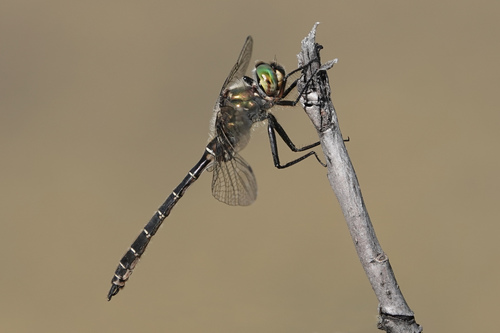
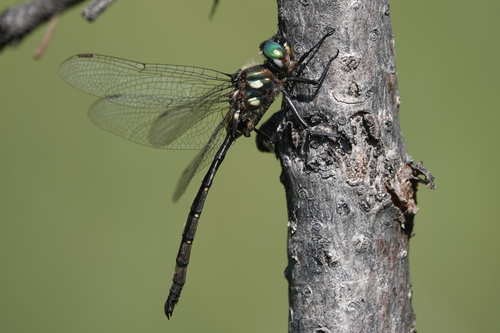
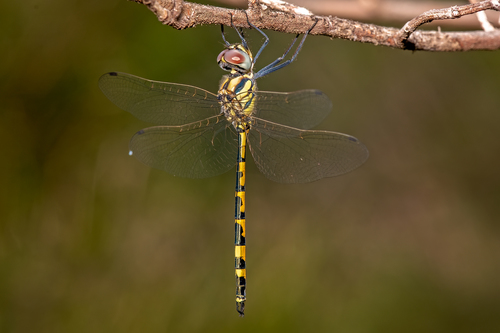
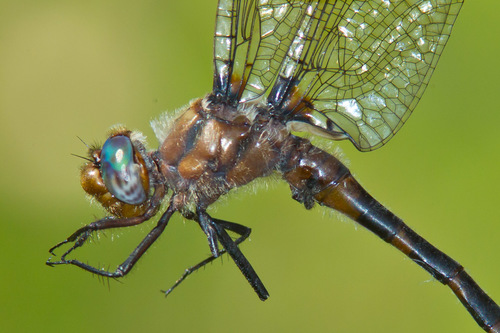
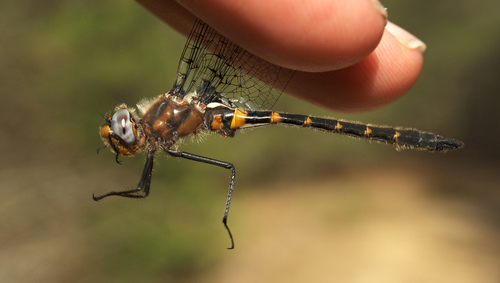
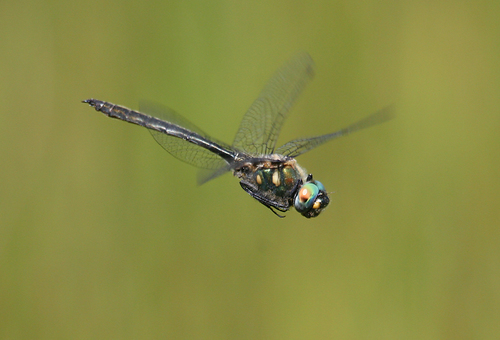
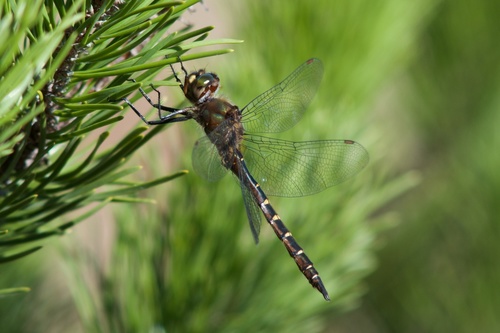
This species is currently classified as Procordulia smithii (White, 1846), and was previously known as Hemicordulia smithii. It has large, globe-like compound eyes that meet at the top of the head. In males the eyes are green with a slight iridescence, while in females they are brown and lack iridescence. The species’ eyes are highly sensitive to movement and changes in light, giving it rapid, radar-like visual responses. The abdomen is long, tubular, and slightly flattened, usually black or dark brown in colour. Rowe (1987) noted that the intersegmental membranes "often appear bright pale-yellow, producing the appearance of narrow, illuminated, widely separated transverse stripes down the abdomen when the species is in flight." The legs are thin and spiny, adapted for seizing prey and carrying it while in flight. Rowe (1987) recorded that legs closer to the body tend to be brown, whereas those further out are black. Norberg (1972) described the wings as having considerable flexibility due to the presence of the nodus, a structural bend located roughly halfway along the wing, which allows the wing to flex during flight. The pterostigma assists in stabilising the wing. The species typically measures 46–50 mm in total length. Specimens from the Chatham Islands have been reported to show colour variations compared with mainland New Zealand individuals. This species is now considered endemic to New Zealand, and it shows strong affinities with Australian and Pacific species. Rowe (1987) noted that when the species was classified as Procordulia smithii, it shares features with the broader Hemicordulia–Procordulia group found throughout Australia and the Pacific, and suggested that the species may have colonised New Zealand during an interglacial period. It occurs only in New Zealand. It has been recorded on coastal islands, including Little Barrier Island and the Chatham Islands. It is particularly abundant in the Canterbury region of the South Island. Rowe (1987) reported the species as widespread across New Zealand and especially common in the South Island and southern parts of the North Island. However, he also noted an apparent absence from the northern North Island and suggested that this required further investigation. Rowe further commented that the abundance of Procordulia smithii populations had fluctuated since the 1950s. It inhabits a wide range of freshwater environments, including inland wetlands, streams, creeks, swamps, peatlands, marshes, bogs, waterfalls, and fens. Larvae are less frequently found in flowing waters and occur more often in bulrush beds, small bog ponds adjacent to streams, and backwaters or flood ponds. Adults are typically associated with stream habitats, and exuviae are commonly found near ponded or slow-flowing areas. Marinov (2015) also reported that adults may occur in grasslands up to five kilometres away from the nearest water source. Like other dragonflies, this species does not have a pupal stage; the life cycle proceeds directly from larva to adult. Deacon (1979) estimated that the full life cycle of this species, when it was then classified as Procordulia smithii, takes approximately four years to complete. Rowe (1987) reported that females lay their eggs in shallow, still water, but also noted that limited research has led to a poor understanding of maturation periods in New Zealand dragonflies. He suggested that mark-and-recapture studies would help clarify adult longevity and behaviour. Larvae of this species inhabit freshwater and brackish environments. They remain aquatic until developing wing sheaths roughly halfway through their growth, after which they begin leaving the water. Ware and Herrera (2012) described the species’ distinctive mating behaviour: pairs form a tandem position leading into a copulatory wheel, a heart-shaped posture characteristic of dragonflies. Copulation involves indirect fertilisation via secondary genitalia located at the base of the abdomen in both sexes. Rowe (1987) noted two periods of peak adult abundance: late December to early January, and again in late February.