About Procnias tricarunculatus (J.Verreaux & E.Verreaux, 1853)
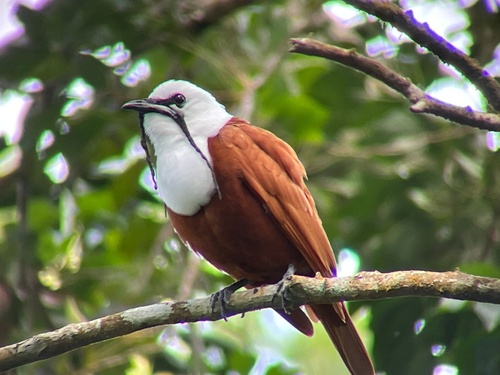
The three-wattled bellbird, with the scientific name Procnias tricarunculatus, is one of four bellbird species native to Central and South America. Adults of this species measure between 25 cm (9.8 in) and 30 cm (12 in) in length. Males have uniformly chestnut-brown bodies, tails, and wings, with white on the head, neck, and upper breast, and a black eye-ring, eye-stripe, and bill. The species gets its name from three worm-like wattles of skin that hang from the base of the male's bill. These wattles can reach up to 10 cm (3.9 in) long when extended during songs and social interactions, and they remain flaccid even when extended. Males shake the wattles during displays, but the wattles otherwise hang straight down—they are not erectile and are not under muscular control. Unlike depictions in some old illustrations and specimens, the side wattles do not stick outward to the sides, and the central wattle does not point directly upward. The biological purpose of these wattles is currently unknown. Females are smaller and less visually striking than males: they are overall olive with yellowish streaking on their underparts, have a pure yellow vent, and do not have wattles. Their plain coloration helps them blend into forest surroundings, which hides their nests from predators. As a result, the nests are extremely difficult to locate. As of January 2019, only six nests had been found in Monteverde, according to the council for the Bellbird Biological Corridor. Juvenile males are often mistaken for females, as they share the same female plumage until they reach sexual maturity at 7 years old. As males mature, they gradually molt their green and brown feathers and grow the distinctive white and copper adult plumage. Males do not start growing their wattles until they are 1 to 2 years old, and the wattles continue to grow for the entire rest of the male's life. The three-wattled bellbird is famous for having one of the most unusual and distinct vocalizations of any bird in its range. Its distribution extends from western Honduras south to eastern Panama. These bellbirds breed primarily between March and September in the cloud forest highlands of Costa Rica, then move to lower elevations in mangrove areas for the remaining months of the year. This species is entirely frugivorous, meaning it eats only fruit. It swallows fruits from trees in the Lauraceae family, which includes avocados. The three-wattled bellbird plays an important role in seed dispersal for these trees: it regurgitates undigested seeds and deposits them in gap areas beneath its singing perches, which nearly doubles the survival rate of the resulting seedlings.