About Procnias nudicollis (Vieillot, 1817)
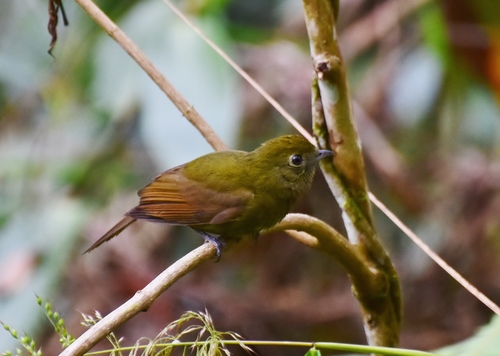
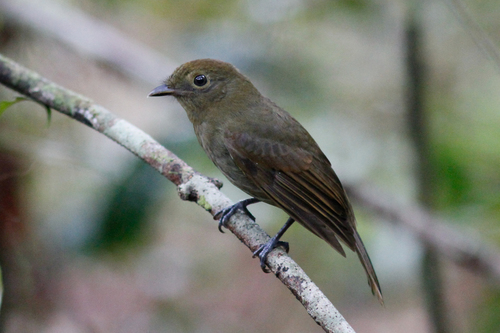
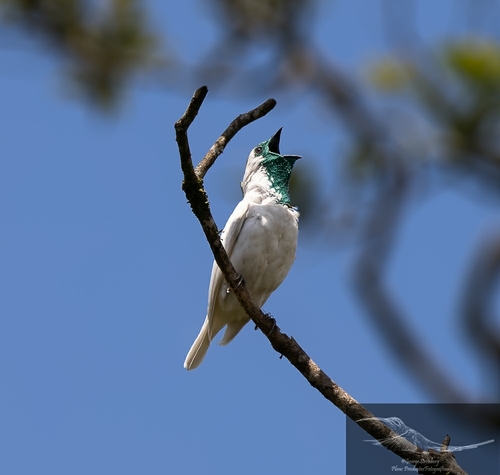
The bare-throated bellbird, with the scientific name Procnias nudicollis, is a bird species in the cotinga family Cotingidae. This species measures about 27 cm (11 in) long. Like other bellbirds of the genus Procnias, it has a short bill with a very wide gape. Males have striking white plumage and bristly, bare bluish-black skin around their eye, beak, and throat. Females are more drab and dull in color: they have a black crown, olive-brown upperparts, and yellowish underparts that are streaked with olive green. The male of this species produces one of the loudest bird calls currently known; the call is a metallic sound similar to a hammer striking an anvil. The bare-throated bellbird feeds exclusively on fruit, and plays a role in dispersing the seeds of forest trees. It is native to Argentina, Brazil, and Paraguay. It is common in Brazil and Paraguay, but rare in Argentina, where fewer than 250 mature individuals were estimated to live there in 2017. Unlike many other cotingids, this bellbird migrates seasonally to different altitudes in Paraguay and eastern Brazil, with migration patterns tied to fruit production and the age class of individual migrating birds. Some evidence indicates it is also migratory in southeastern Brazil and nearby parts of Paraguay, and only visits Argentina. Its natural habitats are subtropical or tropical moist lowland forest and subtropical or tropical moist montane forest. It prefers primary forests, but can also be found in secondary forests that contain fruit trees, as well as abandoned rubber groves. Despite its threatened status, individual bare-throated bellbirds have been spotted in unusual urban settings: a juvenile male was photographed foraging on a campus of the Federal University of Rio de Janeiro in 2007, located on an artificial island near the heavily polluted Guanabara Bay, and another specimen was spotted in 2005 at São Paulo's Ibirapuera Park. The bare-throated bellbird is classified as Near Threatened. It is threatened by habitat loss caused by agricultural conversion and deforestation; only 10% of its historical range in six Brazilian coastal states from Bahia to Paraná remains after deforestation. Additional threats include collection for the pet trade, urbanization, industrialization, and road-building.