About Procnias averano (Hermann, 1783)
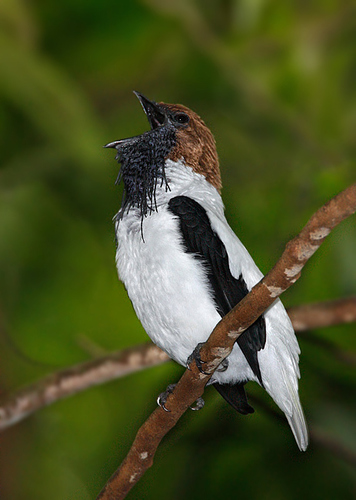
Like other cotingas, the bearded bellbird (Procnias averano) has a broad hooked-tipped bill, rounded wings, strong legs, and a striking appearance. The male is approximately 28 cm (11 in) long and weighs 180 g (6+1⁄2 oz). His plumage is white or greyish-white, with the exception of black wings and a warm brown head. He has a "beard" made of unfeathered, black stringy wattles. The female is smaller, measuring approximately 27 cm (10+1⁄2 in) long and weighing 130 g (4+1⁄2 oz). Her upperparts are olive-green, which is duskier on the head, most of her underparts are yellow streaked with green, and her vent is pure yellow. She does not have the facial wattles that form the male's "beard". Both sexes have dark eyes, a black bill, and grey to black legs. Male bearded bellbirds produce advertising calls: a very loud, dull Bock repeated every few seconds, and a somewhat quieter, metallic hammering tonk-tonk-tonk-tonk. This hammering call sounds like a hammer rapidly striking an anvil, and is repeated 20 to 30 times. A number of regional call variations are also known: an unmusical, almost hissing bisset in southern Venezuela, and a disyllabic teek-terong in northern Venezuela. The teek-terong call is apparently no longer heard in Trinidad. Females are essentially silent. The bearded bellbird is native to Venezuela, adjacent parts of Colombia and Guyana, Trinidad and Tobago, and northeastern Brazil. It lives in humid forests and woodland. It is mainly a resident species, but some populations undergo altitudinal migrations: they breed at altitudes up to 1,900 m (6,200 ft) and spend the non-breeding season in the lowlands. There are two recognized subspecies: the nominate taxon P. a. averano, found in northeastern Brazil, and P. a. carnobarba, found in Venezuela, Trinidad, extreme northeastern Colombia, western Guyana, and far northern Brazil. It is a localised and uncommon bird in Venezuela, but fairly common in Trinidad. The nominate Brazilian race is relatively rare, due to extensive habitat destruction across its range and heavy trapping for the cagebird trade. As a result, it is considered "vulnerable" by the Brazilian environmental authority IBAMA. These arboreal bellbirds feed entirely on fruit and berries, which they mostly take while on the wing. They particularly favour plants from the Lauraceae and Burseraceae families, and also use Araliaceae and Melastomataceae. Female bearded bellbirds feed regurgitated Lauraceae to their young. The female builds a flimsy nest made of twigs, which is usually placed in the outer branches of a tree. Nests are not located in dense jungle, but instead in free-standing trees in semi-cleared areas. This placement likely reduces the risk of predation from common jungle nest predators such as monkeys, toucans, and snakes. The female alone incubates the single egg, which is light tan with brown mottling. This leaves the polygamous male free to spend most of his time calling to advertise with his distinctive songs. The laying season varies across the species' range: it runs from April to November in Trinidad, and from May to September in northern Venezuela. The first recorded bearded bellbird egg was discovered near Cumaca, Trinidad, in the mid-1950s.