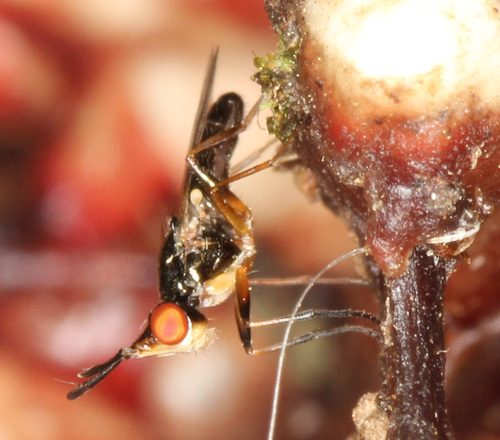
About Prochyliza xanthostoma Walker, 1849
Prochyliza xanthostoma Walker, 1849, commonly called waltzing flies, are also known as cheese skippers. Adult waltzing flies have narrow brown bodies. Their legs are orange on the side closest to the body and black on the side farthest from the body. They have a thin strip of silver-colored marking below their eyes. Their wings are brownish-yellow, and their total body length ranges from 4 mm to 6 mm. This species has elongated antennae, heads, and forelegs. Elongated body form in male P. xanthostoma is a sexually selected trait, and the strength of selection on this trait shows condition dependence, meaning it depends on how exaggerated the trait already is. Males of this species have a mean head length of 1.24 mm and mean head width of 0.84 mm, while females have a mean head length and width both of 1.04 mm. Males have a mean antenna length of 0.98 mm and mean foretibia length of 1.04 mm; females have a mean antenna length of 0.61 mm and mean foretibia length of 0.95 mm. This species is distributed across North America. Adults are most commonly found near carcasses, where they lay eggs, during spring, summer, and fall. P. xanthostoma larvae develop in carrion, with moose carrion being a particularly common natural substrate. Larvae can now also be found in human-consumed animal products including cheese and meats, which is how the species earned the common name "cheese skipper". Adult waltzing flies feed primarily on carrion, but will also eat fungi, cheese, and a variety of other foods. In laboratory experiments studying this species, researchers approximate a natural cheese fly diet by feeding flies aged lean ground beef that has been left for several days.

